I’ve spent years watching robots trip over their own feet in controlled labs while promising to revolutionize logistics. So when I read that an AI model just solved a 45-year-old number theory problem, my first instinct wasn’t awe—it was skepticism. We see the demos; we rarely see the messy reality of deployment. But this isn’t a robot arm stacking boxes. This is pure logic, and if the math holds, it’s a different kind of breakthrough.
OpenAI’s latest model, GPT-5.2 Pro, has independently proved an Erdős conjecture. The proof was verified by Fields Medalist Terence Tao and described as “the clearest first-of-its-kind result (with primary AI contribution) to date.”
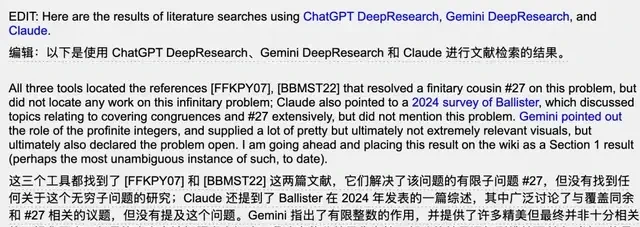
This problem, numbered 281 in the Erdős Problem Database, was jointly proposed by legendary mathematicians Paul Erdős and Ronald Graham in 1980. It concerns the deep relationship between congruence covering systems and natural density. For 45 years, this problem remained unresolved in the database, waiting for a solution. That changed on January 17, 2026, when researcher Neel Somani submitted the problem to GPT-5.2 Pro.
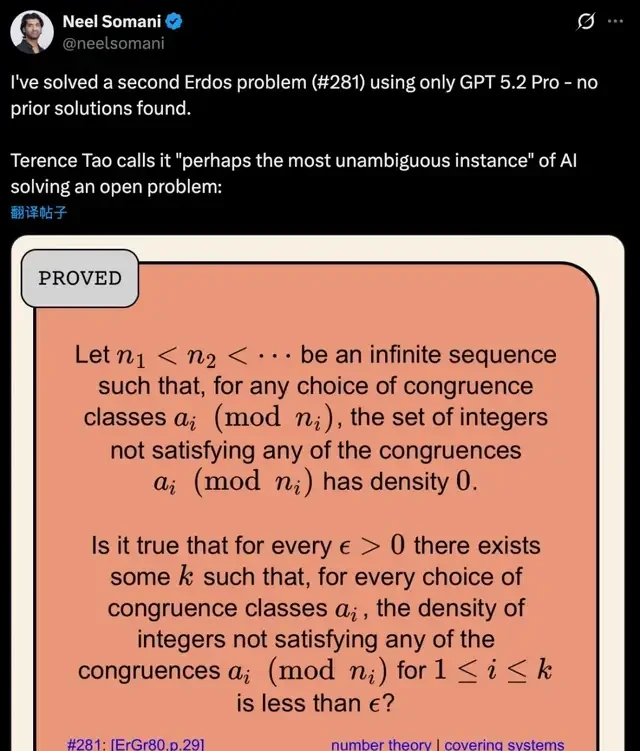
I think lab demos lie, but peer-reviewed math doesn’t care about your marketing budget. I’ve seen models hallucinate code; seeing one avoid quantifier errors is genuinely rare. In the field, if the logic holds, it’s a win for verification, not just generation.
The Proof Relies Solely on GPT-5.2 Pro
The Erdős Problem website has now archived the AI-generated proof. The argument unfolds over the ring of infinite adelic integers, leveraging Haar measure and pointwise ergodic theorems. Combined with compactness arguments, it achieves a transition from pointwise convergence to uniform convergence.
According to Tao, this is a variant of the “Furstenberg correspondence principle,” a standard tool at the intersection of ergodic theory and combinatorics. However, GPT-5.2 Pro’s approach differs slightly from typical arguments, relying more heavily on Birkhoff’s theorem.
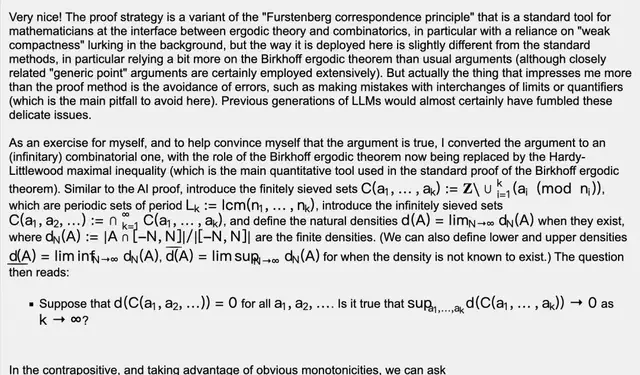
What impressed Tao most was not the method itself, but the fact that the AI made no errors.
What surprised me more is its avoidance of common pitfalls, such as swapping limits or misordering quantifiers—precisely where this problem is most prone to error. Previous generations of large language models would almost certainly have stumbled on these subtleties.
To verify the proof, Tao manually translated the entire ergodic theory argument into combinatorial language, replacing Birkhoff’s theorem with the Hardy-Littlewood maximal inequality and re-running all derivations. Conclusion: The proof holds.
The Shortcut in the Archives
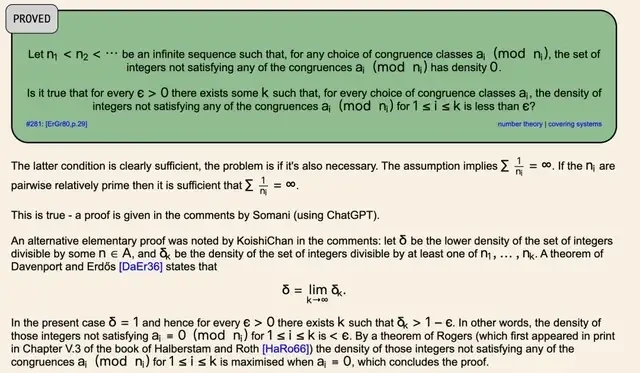
While we were tracking GPT-5.2 Pro’s independent proof, a user named KoishiChan dropped a bombshell in the comments: the problem had already been solved by two theorems from 1936 and 1966.
What I watch for is aI doesn’t discover math; it just finds what humans forgot to cite. I think if the answer was in a textbook, why did we need a supercomputer?
The first is the density convergence theorem, established by Harold Davenport and Paul Erdős in 1936. The second is Rogers’ Theorem, published in Chapter 5 of Halberstam and Roth’s Sequences (1966). Together, these make Problem 281 almost a trivial corollary.
This creates a historical puzzle: Erdős co-authored the 1936 paper, yet when he posed this problem in 1980, he missed that the solution was staring him in the face.
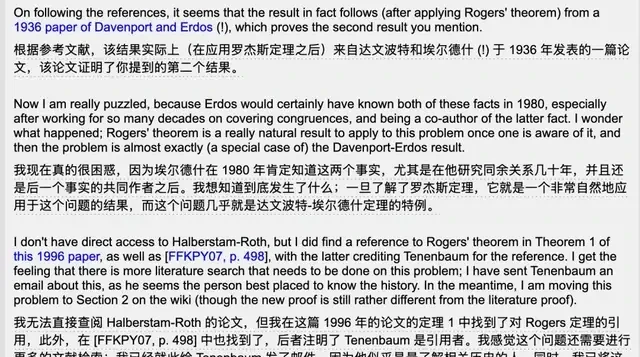
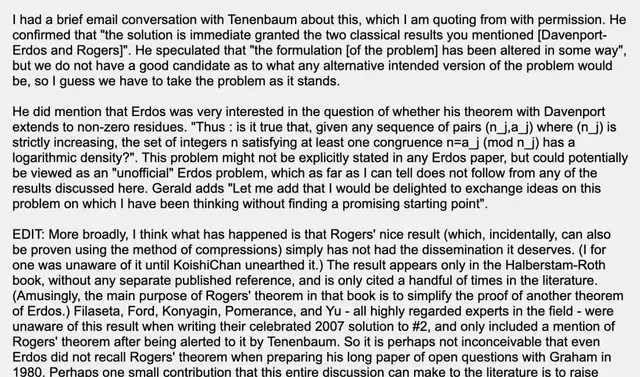
Terence Tao emailed French mathematician Gérald Tenenbaum to clarify. Tenenbaum confirmed that if the Davenport-Erdős and Rogers’ conditions are met, “the problem is immediately resolved.” He speculated the problem statement might have been altered over time, though no other versions exist.
In the field, we pay millions for reasoning when a library search would suffice. What I watch for is the real bottleneck isn’t compute; it’s academic silos.
Tenenbaum’s insight mirrors a 2007 event where five experts—Filaseta, Ford, Konyagin, Pomerance, and Yu—solved another Erdős problem without knowing Rogers’ Theorem. They only cited it after Tenenbaum alerted them.
Tao noted that Rogers’ Theorem lacks dissemination: “It appears only in Halberstam and Roth’s book, was never published separately, and has very few citations.” He hopes this discussion brings attention to the result among sieve method researchers.
We now have two proofs for Problem 281: GPT-5.2 Pro’s ergodic theory approach and KoishiChan’s derivation from classical combinatorics. Tao confirmed they are “different proofs,” despite some conceptual overlap.
The Bias in the Headlines
I read the cross-validation logs, and the narrative is cleaner than the reality. Gemini 3 Pro signed off on the proof’s correctness. Another researcher ran GPT-5.2 Pro repeatedly to stress-test the argument; it flagged only one gap in step two, suggesting a bypass via Fatou’s Lemma.
I think lab models spot syntax errors but miss semantic traps in high-level logic.
Terence Tao caught that trap immediately. He noted the direction of Fatou’s Lemma was applied incorrectly: “I just taught graduate measure theory, and I’ve seen this type of error too many times.” Subsequent verification showed the lemma was actually applied to the complement set, fixing the direction and saving the argument. But the near-miss is the point.
In the field, a single logical slip in a proof is indistinguishable from a hallucination until a human checks it.
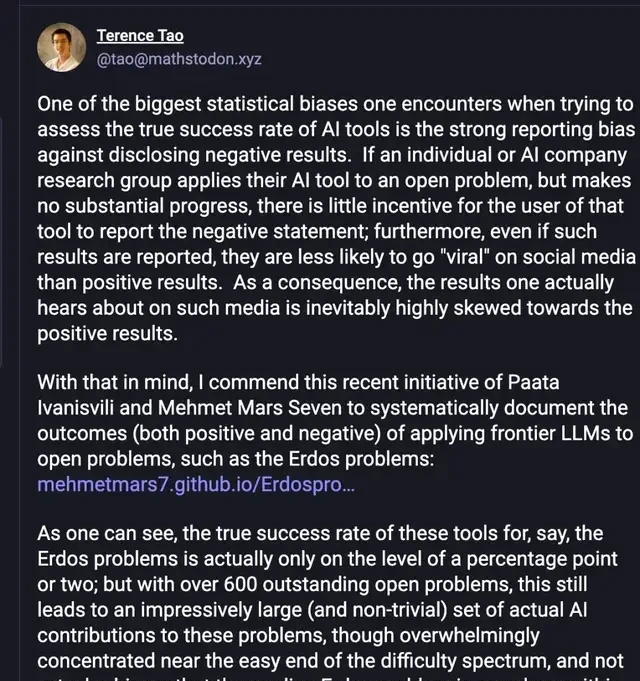
Tao issued a sobering reminder about how we measure progress:
When assessing the true success rate of AI tools, the most significant statistical bias comes from strong reporting bias; negative results are rarely disclosed.
If an individual or an AI company applies a tool to open problems without progress, they have no incentive to report that negative outcome. Even if reported, it is unlikely to spread on social media as widely as positive results.
Although most successes cluster at the easier end of the difficulty spectrum, this does not yet indicate that medium-difficulty Erdős problems are within AI’s reach.
He pointed us toward an open-source project by Paata Ivanisvili and Mehmet Mars Seven to track both wins and losses on Erdős problems. We need that data, not just the press releases.
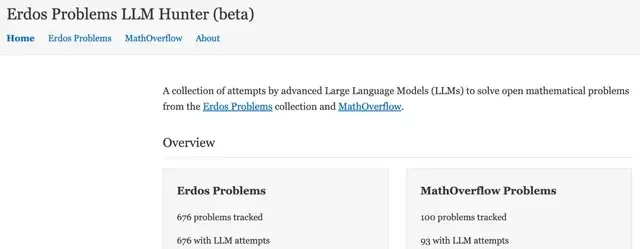
The data confirms the bias. The true success rate of these tools on Erdős problems sits at only about 1% to 2%. That sounds low, but in a database with over 600 unsolved problems, that percentage still represents a substantial and non-trivial number of AI contributions.
What I watch for is one percent is statistically noise until you have six hundred attempts behind it.
Comments
Sign in to join the discussion and leave a comment.
Sign in with Google