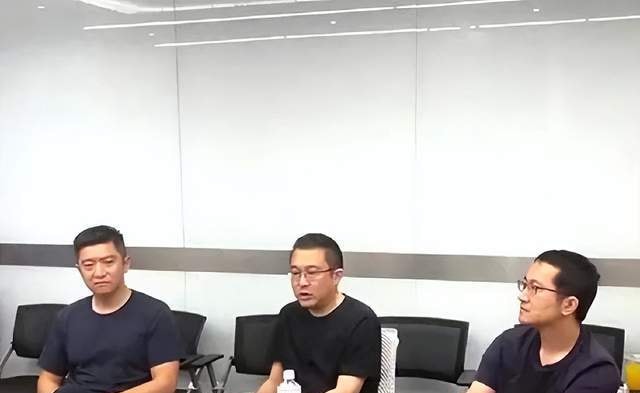
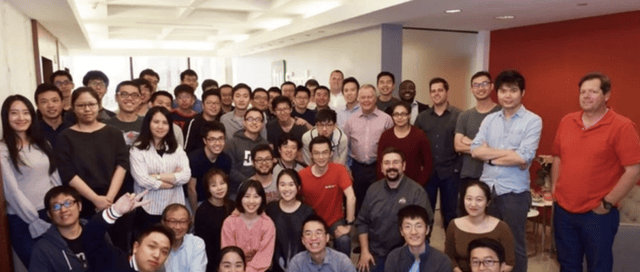
TuSimple claims that a “large volume of false statements” have recently damaged its reputation, but this assertion lacks immediate falsifiability without access to the specific reports cited. The company’s leadership—Chairman Chen Mo, CEO Lu Cheng, and China Region CEO Hao Jianan—has finally appeared publicly as a unified group, signaling an attempt to stabilize a narrative that has unraveled since early 2024.
I followed the timeline of TuSimple’s decline, which reads less like a strategic pivot and more like a collapse. The former No. 1 autonomous driving stock has shed its core business assets in rapid succession: losing all domestic partners in February, halting R&D and commercialization by March, and seeing founding CTO Wang Naiyan depart for Xiaomi Auto in May. That same month, the company settled with North American regulators, a move that often precedes rather than prevents further scrutiny.
I think the timing of leadership appearances after regulatory settlements suggests damage control rather than genuine operational recovery. From the paper, losing all domestic partners and halting R&D indicates a complete abandonment of their primary revenue model. One caveat: the pivot to AIGC games appears disconnected from the technical expertise required for autonomous driving validation.
The narrative complexity deepened in August when TuSimple announced a shift toward AIGC film and animation, followed by an anonymous whistleblower letter in September accusing current leadership of “weaving a huge lie.” Meanwhile, corporate governance remains contested; Hou Xiaodi is set to regain voting rights over his equity shares in November, potentially undoing the board-dissolving agreement previously made with Chen Mo.
I think whistleblower accusations against leadership require independent verification before being dismissed as mere noise. From the paper, the reversal of voting rights agreements highlights ongoing internal power struggles that distract from business operations.
In response to these compounding crises, TuSimple’s senior management provided their first public response. Smart Car Reference transmitted the following details from the communication session immediately.
(The following is the latest record of communication with TuSimple’s management, edited only for necessary background supplementation and reading fluency.)
TuSimple Responds: The Pivot to AIGC Games and the Battle for Control
The core technical claim here is not about autonomous driving algorithms, but about corporate survival mechanics: Chen Mo argues that TuSimple’s pivot away from US operations was a necessary financial correction, while Hou Xiaodi views it as an abandonment of the company’s technological mission. This narrative can be falsified if TuSimple’s new AIGC gaming ventures fail to generate sufficient cash flow to cover the $300 million in annual costs Chen Mo claims needed cutting.
”Hou Xiaodi believes in autonomy; I believe in cash flow”
Question 1: What exactly is your relationship with Hou Xiaodi?
Chen Mo:
When the previous board of directors fired Hou Xiaodi in October 2022, I was unaware of the specific circumstances. We had not been in contact for a long time prior to his dismissal. The day before he was fired, he called me asking if I could help remove those directors first. While I was still considering this request, he had already been dismissed the next day.
I neither agreed nor disagreed with the action. However, some investors and shareholders mediated to encourage my return. At that time, I put forward two requirements: first, Lu Cheng must come back with me; second, Hou Xiaodi must authorize his voting rights to me. Without absolute control, it would be impossible to clean up the mess.
My judgment at the time was that operations in the United States were no longer viable. We needed to cut costs exceeding $300 million annually and practice “cutting off an arm to save the body.” However, on this point, I never communicated with Hou Xiaodi.
I do not know why Hou Xiaodi was dismissed by the board at that time, nor do I know today. Why did he resign to start a new company? To be honest, I don’t know either. I only state objectively that he resigned and started a new company. My guess is that it might be because we decided to lay off TuSimple’s entire U.S. operation.
Of course, we first tried to sell the business; if it couldn’t be sold, we had no choice but to reduce costs.
Hou Xiaodi may feel that autonomous driving is the only path, but I believe company cash flow is the only thing that matters. My goal was to balance revenue as quickly as possible.
One caveat: the reliance on “cash flow” as the sole metric for survival ignores potential long-term valuation gains from retained R&D capabilities. I think assuming $300 million in annual savings are achievable without compromising core IP integrity is a significant operational risk.
Question 2: For two long years, why did you not communicate directly with Hou Xiaodi?
Chen Mo:
He established his new company very early (December 2022) and competed directly with TuSimple. Isn’t that a direct harm to the interests of TuSimple shareholders? So, how do you suggest we communicate?
Question 3: What is the essence of Hou Xiaodi’s style of conduct?
Chen Mo:
Everyone has different beliefs. My personal belief is fiduciary duty. This matter requires real, tangible profits; telling stories is useless. Everyone makes different choices, and I think that is fine.
Lu Cheng:
This isn’t about idealism vs. realism, or tech-focused vs. business-focused factions—that’s all nonsense. Look at the facts: In March 2022, Chen Mo and I left; in May, the CFO left; in July, the General Counsel left. Then Hou Xiaodi was dismissed by the board, which is a very abnormal occurrence—regardless of what faction you belong to.
Secondly, after Chen Mo and I returned, he allowed us to take over. Yet, within such a short period, he founded a company that directly competed with TuSimple. This is extremely irresponsible toward TuSimple shareholders—it has nothing to do with belief; it is an issue of professional ethics.
From the paper, the characterization of Hou’s actions as “unethical” relies on the assumption that a founder cannot pursue parallel ventures post-dismissal without explicit non-compete enforcement. One caveat: the departure timeline of key executives (CFO, General Counsel) suggests deeper governance issues than simple factionalism.
Question 4: TuSimple will hold a shareholder meeting at the end of December. Is there any possibility that Hou Xiaodi will take back control?
Chen Mo:
Hou Xiaodi and I each hold 12 million Class B shares (with identical voting weight). They are equal.
The voting rights authorized by Hou Xiaodi to me this November will expire. Our opinions are clearly divergent, so the outcome depends on how Class A shareholders vote.
Question 5: Reports say that Chen Mo was “pushed out” in March 2022 by Hou Xiaodi? Is that true?
Chen Mo:
At that time, Hou Xiaodi told me I had to choose between two options. Therefore, considering Hou Xiaodi’s technical leadership, I persuaded Lu Cheng to leave the company.
Shortly after, Hou Xiaodi informed me that Independent Director Brad proposed I should resign as Chairman and leave the board to focus on managing Turing Truck, also for better future cooperation with TuSimple. I accepted this.
However, I never communicated directly with Independent Director Brad throughout the entire process.
TuSimple Responds: Pivoting to AIGC Games for Survival
Question 6: Regarding the settlement agreement with the U.S., what exactly did TuSimple do wrong, and why pay such a high price to settle?
Chen Mo:
Geopolitics. The United States has its own politics; China has its own.
I think attributing regulatory penalties solely to geopolitics ignores the specific securities violations that triggered the settlement. From the paper, this vague explanation fails to address whether internal compliance controls were actually improved or merely bypassed.
TuSimple Responds: Pivoting to AIGC Games for Survival
Shareholder Anonymous Whistleblower Letter: How Does TuSimple Respond?
The core technical claim here is that TuSimple’s pivot to AI-Generated Content (AIGC) was a strategic board-approved evolution rather than the fraudulent diversion of assets alleged by an anonymous shareholder. This narrative collapses if evidence emerges showing direct fund transfers from TuSimple to Chen Mo’s personal entities for non-business purposes, or if the “patent licensing” revenue model proves mathematically unviable against existing competitors.
The anonymous shareholder letter primarily targeted TuSimple’s actions prior to the official announcement of pivoting to AIGC, accusing Chen Mo and others of using TuSimple’s funds and resources for film and game businesses long ago, thereby deceiving shareholders.
TuSimple proactively responded to these accusations and explained the current status and future plans for its autonomous driving business.
Regarding Shareholder Allegations on Corporate Structure
1) Regarding shareholder allegations that two newly established entities are unrelated to autonomous driving and are linked to Chen Mo’s personal companies:
Chen Mo: Because foreign-invested companies cannot directly engage in internet businesses in China, everyone uses a VIE (Variable Interest Entity) structure to connect with these companies.
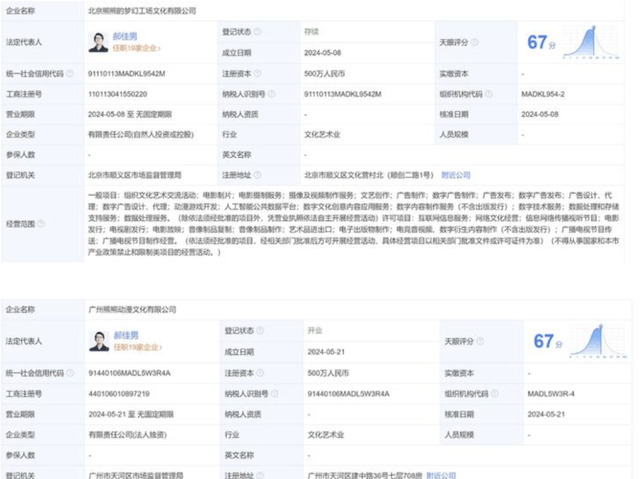
In reality, they belong to companies controlled by the TuSimple Group VIE structure. This method is used by all major companies like Alibaba and Tencent.
Regarding other related companies, Shuimo Xiadao (Water Ink Bandit) is my personal company, stemming from my hobby for animation and games. To date, there has been no financial transaction, no business interaction, and no relationship between this company and TuSimple.
The registered contact information overlaps because registering a company in China requires providing an address. We simply used TuSimple’s address at the time; there is no overlap in personnel.
One caveat: vIE structures are legally opaque by design, making it difficult for shareholders to verify where capital actually resides without internal audit access.
On the Timeline of the Pivot and Operational Changes
2) TuSimple management wove lies, claiming that TuSimple’s autonomous driving business in China was booming and urgently needed large amounts of capital, but never disclosed that the company was quietly pivoting to video games and animation production.
Chen Mo:
In February 2024, a Temporary Restraining Order (TRO) issued by a U.S. Southern California court (prohibiting cooperation with Chinese companies) had a massive impact on TuSimple’s China autonomous driving business, leading to the departure of many core R&D team members. To ensure road testing safety, we gradually reduced autonomous driving R&D and testing activities.
In March 2024, given the challenges and difficulties faced in the autonomous driving sector, the TuSenior management team began preliminary explorations into Generative AI applications and actively communicated with the board of directors; after several months of initial exploration, management believed there were significant commercialization opportunities in the AIGC field.
Therefore, according to the company’s articles of association and governance rules, the TuSimple Group held a board meeting on August 12, 2024, officially approving the establishment of new business directions in Generative AI, formally entering the anime, film, and gaming industries. On August 15, the company officially announced IP licensing and cooperation related to The Three-Body Problem universe.
There was no deception by the company management or CEO toward the board, the public, or the U.S. Federal Court, nor was there any intentional transfer of funds to China. TuSimple Group funds were not used for Chen Mo’s personal investments in video games and animation.
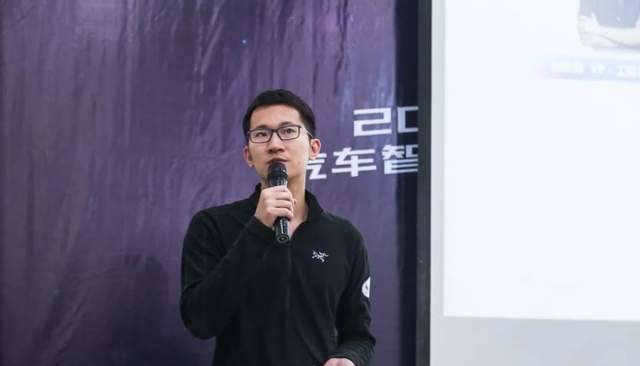
Hao Jianan:
Currently, the TuSimple technical team consists of approximately 200 people, which remains the core team from the autonomous driving days. This advantage can be continued after pivoting to AIGC.
Additionally, after TuSimple suspended autonomous driving-related operations, AWS cloud service costs did not decrease. This is because the annual framework contract was signed with AWS during Hou Xiaodi’s tenure, and the contract included minimum spending requirements. These related resources can be utilized for subsequent Generative AI-related businesses.
I think the claim that 200 autonomous driving engineers are immediately transferable to AIGC production ignores the significant skill gap between robotics software and generative media pipelines.
Future of Autonomous Driving: Patent Licensing
3) Is the autonomous driving business still being pursued?
Chen Mo:
In the future, TuSimple’s autonomous driving business will pivot to patent licensing. This means opening up TuSimple’s existing technology patents and data protocols for use by other commercial partners, earning licensing fees.
We have already contacted two automotive clients, with an expected cooperation scale in the tens of millions of U.S. dollars.
From the paper, licensing revenue from a company that has ceased active development is historically low-margin and highly dependent on the enforceability of patents in jurisdictions where TuSimple no longer operates.
The Pivot: Why TuSimple is Betting on AIGC Games
Elena Volkov
TuSimple claims it is pivoting from autonomous trucking to AI-Generated Content (AIGC) in gaming, citing a $600 billion market and existing technical infrastructure. This move would be falsified if the company fails to demonstrate that its autonomous driving-derived AI models can actually produce commercially viable game assets faster or cheaper than specialized generative tools already dominating the space.
The Business Logic Behind the Pivot
Lu Cheng:
The premise for TuSimple entering AIGC is actually quite normal because executives must constantly seek more commercial opportunities.
There are several points to the specific logic. First, Generative AI is a very hot topic. Starting in March, we communicated with shareholders and the board of directors, who agreed to explore this industry first.
Content and gaming constitute a very large market, with global revenues reaching approximately $600 billion.
One caveat: chasing a $600B market is easy; capturing even 0.1% of it requires moats this team hasn’t shown they possess.
Technical and Management Overlap
Second, through researching the processes of game and animation production, we believe AIGC can create significant value in this sector.
Third, from a technical perspective, TuSimple has spent years on autonomous driving technology, accumulating substantial experience in AI technologies, infrastructure, and large models. Therefore, there is great potential for technological sharing.
Fourth, from a management perspective, we have experience. Before TuSimple, Chen Mo worked in the gaming industry for many years and possesses rich expertise.
I think assuming autonomous driving neural nets translate directly to generative art ignores fundamental differences in data distribution and objective functions.
Strategic Execution: IP and Efficiency
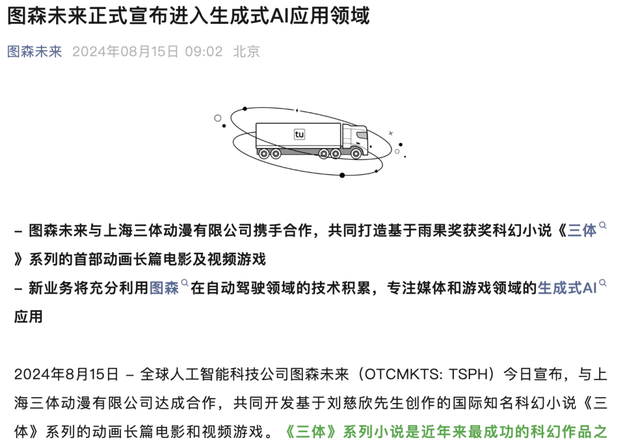
TuSimple’s strategy for AIGC is relatively simple: collaborate with famous major IPs to create high-quality global content and games.
For example, in the officially announced The Three-Body Problem IP project, we use AI technology to reduce costs and accelerate processes, resulting in higher quality content and faster time-to-market.
Above is the logic behind TuSimple’s entry into the AIGC industry.
From the paper, “Higher quality” is a subjective metric that rarely holds up against rigorous user testing or peer comparison benchmarks.
Comments
Sign in to join the discussion and leave a comment.
Sign in with Google