Meituan Instashopping has shifted its AIGC strategy from technical novelty to brand utility, launching two marketing videos that prioritize conveying service capabilities over showcasing generative prowess. This pivot addresses a persistent operational question: how to make AI content stick without relying on gimmicks. The core thesis is simple—AI should act as an amplifier of brand value, not just a source of eye-catching visuals.

The industry standard is quietly moving away from asking if AI can generate flashy content, toward whether that content clearly articulates brand positioning. If the output leaves no trace in user memory, it’s wasted effort. Meituan Instashopping collaborated with AIGC creators to produce two case studies demonstrating this shift, including a viral piece dubbed the “Meituan Instashopping version of Journey to the West.”
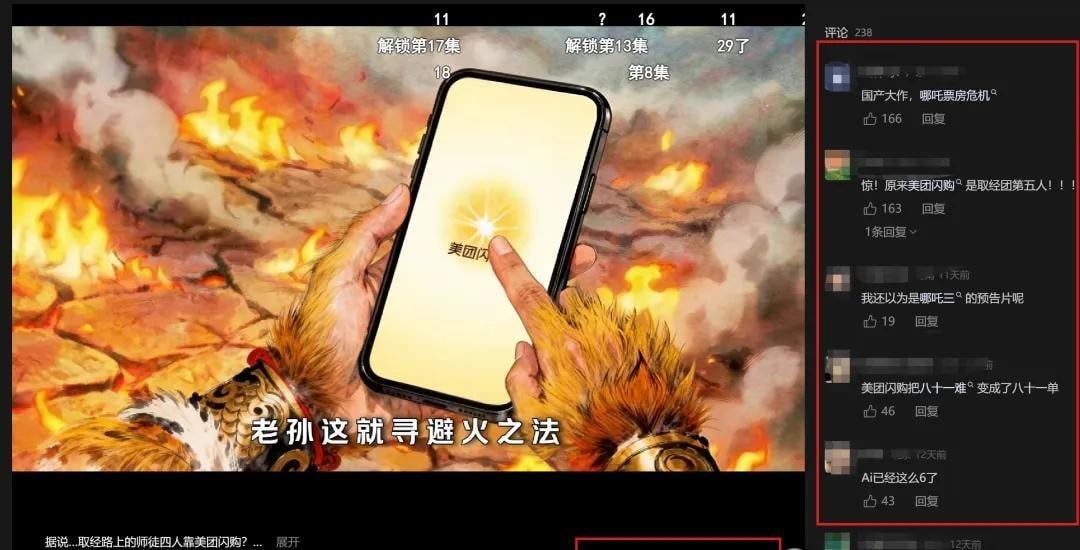
The strength of this campaign lies in its restraint. Instead of rushing to prove AI’s power, it uses absurd yet logical creative ideas to illustrate the platform’s ability to deliver quality goods within 30 minutes. It is a smart form of tech-driven marketing where users know it’s an ad but watch until the end anyway.
Video Breakdown Show Time
To understand the strategy, I’m adopting the client perspective: How do we use algorithm-generated surreal imagery to concretize “30-minute delivery” capabilities? The brief requires executing scripts traditional TVCs struggle with, embodying the philosophy that technology serves creativity, and creativity serves users.
The core requirements boil down to two metrics:
- Can AI effectively convey brand messages like timeliness and diversity?
- Is the information clearly perceived by the audience, driving conversion?

I will evaluate these videos based on whether the value proposition hits the mark, focusing separately on the most prominent aspect of each piece. While both showcase speed and variety, I’m isolating their distinct strengths for clarity.
In practice, viral surrealism doesn’t reduce inference costs or latency in production pipelines. I think treat AIGC as a brand amplifier, not just a content generation tool. Operationally, measurable conversion matters more than technical novelty in real-world deployments.
The Latency of “Instant” Retail: Speed as a Feature, Not Just a Promise
I read through the breakdown of Meituan Instashopping’s new AIGC campaign, and what stood out to me wasn’t just the creative execution—it was how they weaponized perceived latency. In our world, we obsess over millisecond response times; here, they’re selling sub-30-minute physical delivery as if it were a real-time API call.
The core narrative hinges on “Meituan Instashopping Express Delivery,” but let’s strip away the marketing gloss for a second and look at the mechanics of attention capture. The video compresses complex logistical promises into a 60-second burst of high-energy pacing, using Journey to the West tropes as a familiar UI pattern for viewers.
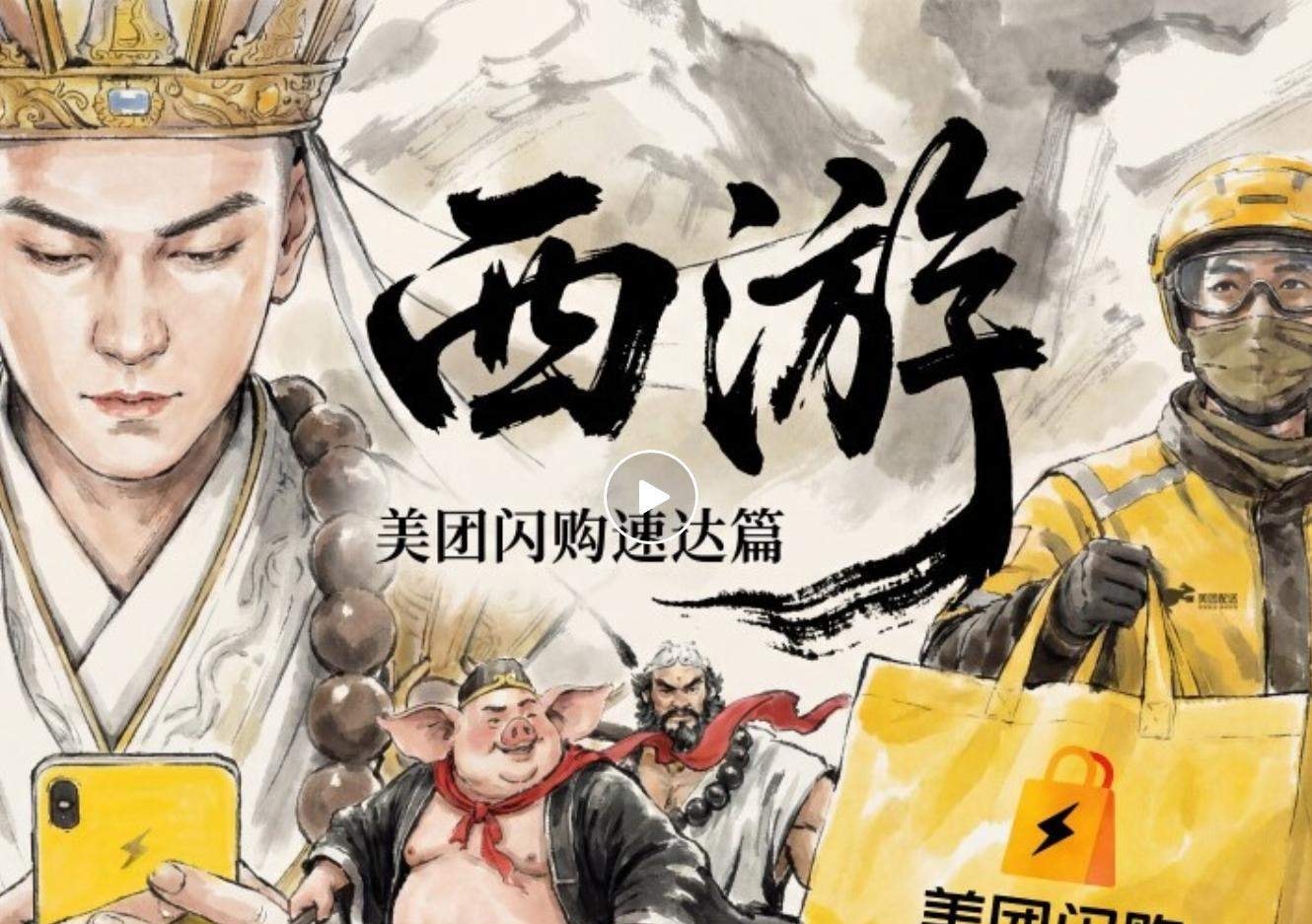
Video Link: https://mp.weixin.qq.com/s/E0YqXZVYLhGVvMssU16EHA
In just over a minute, “Meituan Instashopping” descends upon three familiar mini-stories with the arrival of divine weapons. Paired with high-energy BGM and visual effects, the overall feeling after watching can be summed up in one word: Satisfying!
And once that thrill subsides, filtering out all other information, you’ll suddenly realize your brain has unconsciously absorbed a specific takeaway—
Whatever you urgently need right now, Meituan Instashopping will appear and deliver it immediately.
At this point, you know it’s done—the ad has entered your mind in another way (doge).
So how did they achieve this? It’s actually quite simple, relying on two core elements:
First, by borrowing wildly creative plots to naturally integrate the brand philosophy of “quality goods within 30 minutes” and “instant problem-solving” into well-known scenes from Journey to the West, allowing viewers to quickly get hooked in a short time.
Second, through repetition, constantly reinforcing the impression.
And then, some kind of “magic” naturally occurs.

Looking specifically at this video, you’ll notice that its entire logic and pacing emphasize “speed.”
One moment, the master and disciples are in dire straits—flames raging at the Flaming Mountains, the Great Sage being subjected to his master’s chanting spell, sandstorms swirling at Huangfeng Ridge. The situation is urgent and fraught with hardship.
The next second, following a familiar trope (cue recognition), whether it’s solid mango pomelo sago used to extinguish fires… or a decompression head massager to relieve the pain of the tight-fillet spell—all are swiftly delivered by “Meituan Instashopping.”
There is no waiting, no “let’s figure something else out”; instead, only one thing is emphasized—
You need it, and it arrives.
Moreover, the gap between this need and its fulfillment is infinitely compressed by the high-energy video pacing and special effects.
As a result, the viewer experience becomes extremely direct. You don’t even have time to question its rationality; instinctively, you just feel, “Wow, that was fast.”
It is precisely at this point that the video accurately captures the biggest difference between “instant retail” and “traditional e-commerce.”
Traditional e-commerce often offers “next-day delivery at the earliest,” with a service logic based on planning and waiting. In contrast, Meituan Flash Shopping emphasizes “good goods in hand within 30 minutes” (which can be understood as a “30-minute version of traditional e-commerce”), essentially aiming to eliminate wait times.
In practice, this is a classic case of shifting the bottleneck from digital latency to physical logistics. If your supply chain can’t support that SLA, the ad becomes a liability, not an asset.
Therefore, this AI video establishes the technical mindset that “instant retail is the optimal solution for modern life” through the visual satisfaction of “delivery upon ordering,” making people’s perception of “speed” more vivid and concrete.
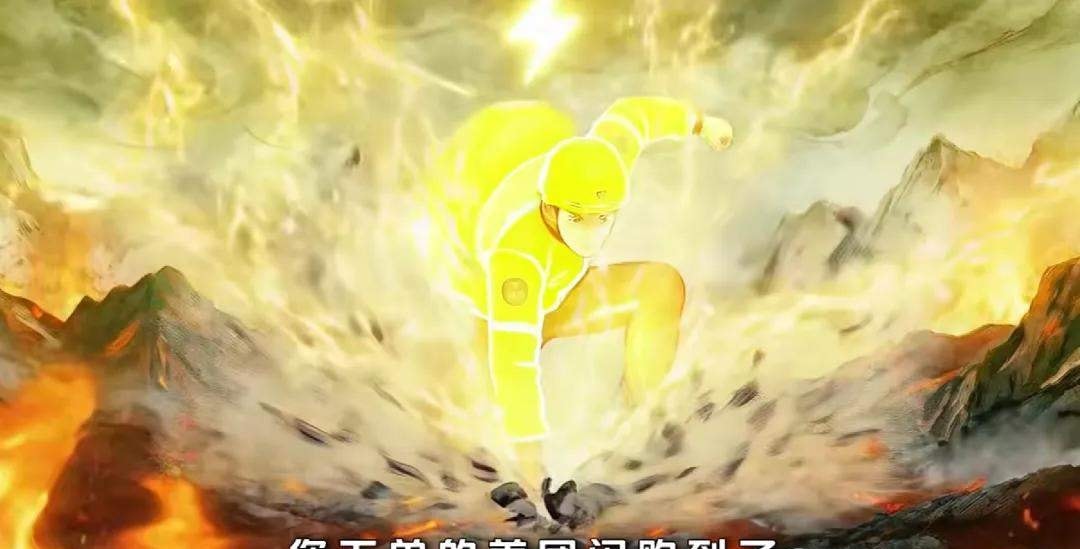
It is also worth noting that high-difficulty visual effects such as “extinguishing the flames at Flaming Mountain” and “removing sand from Huangfeng Ridge,” if produced using hand-drawn animation or CGI, would undoubtedly require massive budgets and timelines.
However, with AI, these “exaggerated effects” have become accessible:
This not only frees brand creativity from budget constraints but also subtly presents a stark contrast—on one side are the seemingly insurmountable grand dilemmas rendered by AI; on the other is Meituan Flash Shopping’s lightweight, instant, and almost effortless solution.
When these two elements appear in the same frame, the “lightness” and “extreme speed” conveyed by Meituan Flash Shopping’s promise of “good goods in hand within 30 minutes” are further amplified.
I think using AI to simulate high-cost production is smart for marketing ROI, but it doesn’t fix backend inventory sync issues. The tech stack behind the scenes needs to be as agile as the video editing.
Mythology Chapter: Everything is Accessible, Easily Breaking Physical and Spatial-Temporal Limits
The production implication here isn’t just creative flair; it’s a stress test on AI consistency at scale. If the model can seamlessly blend modern SKUs into ancient mythologies without breaking immersion, the underlying pipeline for asset generation is robust enough for real-world deployment.
Operationally, this proves generative pipelines can handle complex semantic blending, not just simple image-to-image translation. In practice, the “no-explanation” narrative reduces the need for rigid prompt engineering constraints on product placement. I think smooth transitions via shared elements like rain or motion are a cheaper alternative to full scene re-rendering.
In this second video, the focus shifts to another aspect of instant retail—the diversity of good products.
As per our usual format, let’s look first and then analyze:

Video link: https://v.douyin.com/QZC-1LsKgzg/
If the keyword for the Journey to the West chapter is “speed,” then the first impression of the Mythology chapter leans more toward “richness.”
This change stems primarily from adjustments in narrative structure.
The Journey to the West chapter is driven by a single story throughout, making its pace naturally controllable and easier to accelerate. The Mythology chapter, however, stitches together several stories, allowing this “breadth” to better reflect differentiated needs across various scenarios.
Ultimately, whether it is Hou Yi shooting down the sun, Bai Suzhen and Xu Xian’s paper umbrella romance, or Nuwa creating humans, although the characters, situations, and problems change, the method of resolution remains highly consistent:
Whenever a need arises, “Meituan Flash Shopping,” dispatched by the Jade Emperor, suddenly appears and quickly fulfills its role.
This uniform handling continuously sends the same signal to the audience:
Needs are diverse, but supply is stable.

The greatest challenge in achieving this goal lies in how AI handles the integration of modern products like sunscreen, parasols, and modeling clay with ancient settings, as any element appearing out of place could easily break immersion.
Judging from the final result, this video resolves this issue through two main approaches.
First, it does not pre-establish rationality. The Mythology chapter deliberately downplays explanations for “why these items appear.” In the video, the coexistence of modern products and ancient myths is treated as a default premise rather than something that needs to be proven.
This technique, akin to setting world rules, allows audiences to accept this cross-temporal fusion more quickly.
Second, transitions are handled with greater subtlety. For example, the transition from Hou Yi shooting down the sun to the West Lake scene utilizes “rain” as a common element; the shift from Bai Suzhen to Nuwa is connected through “hand movements,” complemented by rhythm-matched music, making the scene changes appear smoother.
In any case, through this strategy of “setting first, smooth transitions,” the Mythology chapter not only showcases Meituan Flash Shopping’s diversity in non-food categories such as digital products, beauty items, and daily necessities but also subtly helps audiences build a more abstract cognition:
What instant retail provides is not just specific types of goods, but a supply capability that has erased spatial and temporal limitations.
The role played by AI here extends beyond generating these visually breaking-of-physical-limits fusion scenes; it also implants the psychological suggestion that “everything is accessible” through visual repetition and reinforcement.
At this point, the logic behind the two videos becomes clear:
They use AI-generated “surreal” scenarios as a shell to wrap around Meituan Flash Shopping’s two extremely fundamental value cores: “speed” and “variety.”
By the criteria set at the beginning, they have achieved the first point. As for how effective the second is, that depends on your feelings after watching.
No-Shoot Ads? A Deep Dive into Meituan Instashopping’s New AIGC Marketing Case
Hidden Meanings Behind the Videos
Meituan Flash Shopping’s campaign signals a structural shift in how AI operates in marketing, moving beyond simple generation to narrative support. I read through their release notes and case studies; what stood out is that they aren’t just using AI as a faster brush for posters, but as infrastructure for story structure. This lowers the barrier for high-concept visuals without letting the tech distract from the brand message.
Operationally, shippable today if you treat it as an asset generator, not a creative director. The trade-off is quality control on narrative coherence versus raw speed.
For years, AI in marketing has been rudimentary—generating static images or turning them into basic videos. It acts as an efficiency tool, satisfying the desire to try new things and speeding up processes, but rarely intervening in the content structure itself. Meituan’s practice shows AI taking on a role leaning toward Content Infrastructure.

Once AI participates in narrative structure, the change extends beyond production efficiency. It forces us to ask what kind of creativity we actually want technology to achieve. This marks the starting point for shifts in creative production models. The marketing field isn’t short on good ideas; realization is often constrained by cost and technology.
In practice, we need deterministic pipelines for these assets, not just stochastic generation. You can’t put a lab demo in production without versioning and rollback strategies.
Consider grand concepts like “mythological figures using modern products.” Traditional hand-drawn animation combined with special effects requires incalculable human and material resources. Bi Gan recently revealed on Luo Yonghao’s podcast that a 15-minute fantastical commercial took him several months to complete, highlighting the high costs of traditional methods. AI now significantly lowers this barrier.
There is no need for physical sets or expensive post-production; AI generates these visually stunning scenes directly. This gives ideas previously stuck in scripts their first opportunity to be validated at low cost and iterated repeatedly. AI is returning marketing power from “budget” back to the “idea” itself.
I think treat these models like any other dependency—monitor for drift and update costs. If the API changes, your ad campaign breaks overnight.
Judging by the final output, AI has not upstaged or distracted the audience; it serves the brand’s marketing creativity. Audience feedback focused on “Meituan Instashopping” rather than “the relationship between this video and AI.” Technology has quietly retreated into the background while brand value and user perception have been brought to the forefront.


This raises the question: Why did Meituan Instashopping dare to embrace AI first and successfully navigate this path from “technology application” to “brand value expression”? The answer lies within the premise itself.
No-Shoot Ads? A Deep Dive into Meituan Instashopping’s New AIGC Marketing Case
Why Meituan Instashopping?
I read this case study because the business model itself dictates the technical approach. Meituan Instashopping is Meituan’s instant retail platform, defined by its official introduction as relying on “instant delivery capabilities” to meet immediate needs for “everything delivered within 30 minutes.” The brand slogan is simple: “Instashop once, get good goods in hand within 30 minutes.”
Opening the mini-program application interface looks something like this:
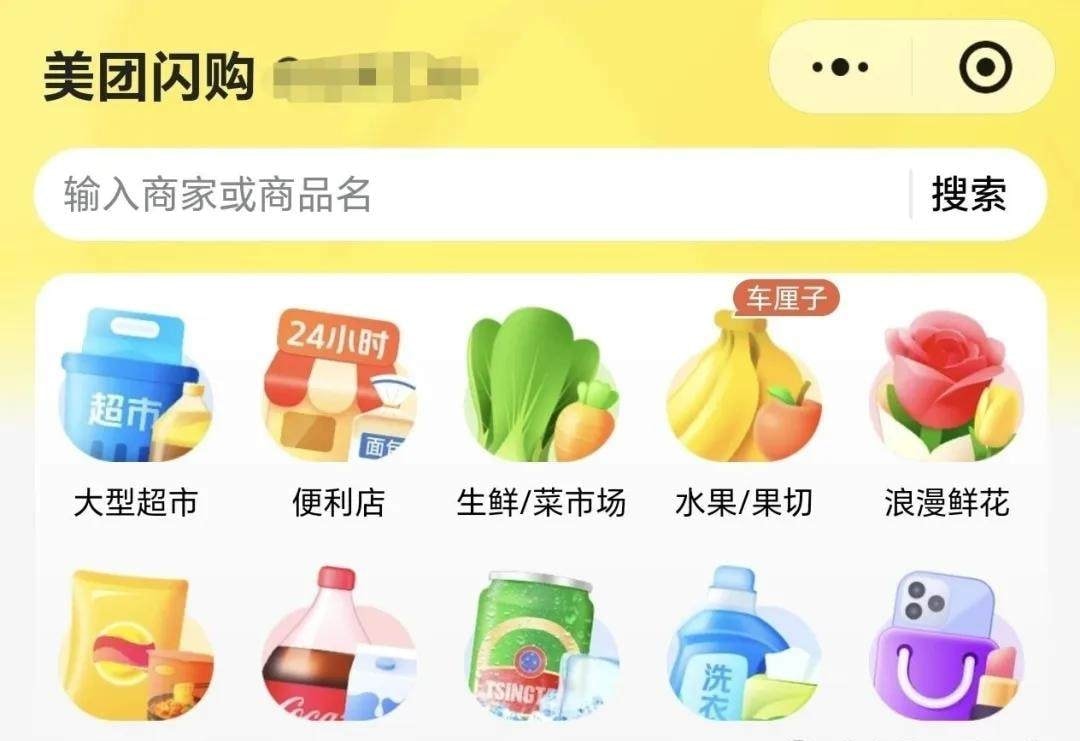
The service categories cover supermarkets, convenience stores, fresh ingredients, fruits, flowers and plants, snacks, and more. Its advantage can be summarized in one sentence:
Broader than food delivery, faster than traditional retail.
On one hand, it leverages an instant delivery system (with millions of active riders daily) to guarantee “good goods delivered within 30 minutes.” On the other hand, it covers a wider range of consumption scenarios including digital products, cosmetics, daily necessities, and emergency supplies (food categories belong to Meituan Waimai).
This means that Meituan Instashopping naturally faces high-frequency, fragmented, and highly immediate demands. This business attribute resonates fundamentally with the “instant generation” and “infinite creativity” of AIGC.
First, resonance in efficiency.
The “immediacy” inherent in AI-generated content aligns closely with the “immediacy (30-minute delivery)” emphasized by Meituan Instashopping’s business model. This is particularly evident in the Journey to the West series. Beyond the fact that AI can generate content quickly, the plot design vividly conveyed this sense of immediacy.
Operationally, latency matters less when the physical delivery promise is already 30 minutes.
Second, resonance in expressive boundaries.
Physical filming is limited by budget, timelines, and physical laws, whereas the computational advantages of AI generation naturally fit Meituan Instashopping’s characteristic of “having everything.” In the mythological series, AI can match diverse needs by generating different scenes and the corresponding products required. This echoes Meituan Instashopping’s real-world advantage of product diversity.
In short, it is precisely because Meituan Instashopping’s business core and AIGC’s generation logic have formed a high degree of synergy in the dimensions of “speed” and “variety” that this tech-driven marketing campaign has moved beyond mere technical showmanship. To put it bluntly, at its core, this is actually a model of “technology empowering business.”
At this point, some might ask (pretending to pose a question): Can’t others just replicate this case?

Not necessarily. The true value of this case for industry reference lies in the more fundamental and replicable methodology it provides:
Effective AIGC Marketing = Clear Self-Awareness + Accurate Utilization of AI Narrative Capabilities.
As stated at the beginning of this article, the biggest challenge facing current AIGC marketing is: When “knowing how to use AI” is no longer scarce, what becomes truly scarce is knowing what to do with AI and why. The merit of Meituan Instashopping’s marketing campaign lies in its clear answers to these two fundamental questions:
- Who am I? A brand emphasizing “speed” and instant retail platforms with a vast selection.
- What can AI do for me? Using AI to concretize “speed” and “variety” (which AI tools can achieve this, and which cannot).
Therefore, for latecomers, the key is not to replicate the same creative ideas, but to master the same thought process: first clarify the brand’s core value, then find resonance between technology and that value. Otherwise, if one skips the business core and starts directly from “which generative model is the coolest right now” or “how can AI beautify this product,” the resulting content will likely remain at a level that looks good and is fun to play with, but may not be memorable or effective in driving conversions.
Of course, under this methodology, Meituan Instashopping, as a player closer to users’ daily lives, indeed possesses certain marketing advantages. The lo
The production implication here is clear: Meituan Instashopping isn’t selling AI; they’re selling reliability at scale. If your platform can’t handle the “urgent moments” of user demand without latency or failure, no amount of AIGC flair will mask the operational debt.
In practice, marketing hype doesn’t fix broken SLAs; uptime does. I think emotional value is nice, but low-latency delivery is non-negotiable. Operationally, if the AI generates a request faster than your logistics can fulfill it, you’ve created a worse user experience.
The Human Cost of “Tech for Creativity”
The logic is simple: if you were asked to promote a SaaS product or superconducting materials using AI, explaining the concepts alone might be exhausting. But Meituan Instashopping is clearly different.
So, in a sense, while the success of the Meituan Instashopping case cannot be separated from the principle that “technology serves creativity,” what matters even more is the latter half:
Creativity serves users.
Here, whether it is technology or creativity, both are ultimately just means to serve users.
Operationalizing “Urgent Moments”
The daily “urgent moments” precisely restored by AI in the video—from umbrellas needed urgently during a rainstorm to ingredients suddenly short on hand—prove that “getting good goods within 30 minutes” is never an empty marketing slogan, but a value promise that users can truly perceive.
It resonates because it hits upon the most real anxieties of modern life: when plans are disrupted and needs arise suddenly, what users need is not just “speed,” but a reliability they can count on at any time.
And in this fast-paced era full of variables, such certainty itself is a very scarce emotional value.
The Trade-Off: Warmth vs. Latency
Therefore, Meituan Instashopping’s choice to use cutting-edge AI as its outward expression does not aim to convey technology itself, but rather those unpretentious yet highly relevant service values—speed and variety.
And when cold algorithms begin to respond to users’ real needs, technology truly gains warmth.
Comments
Sign in to join the discussion and leave a comment.
Sign in with Google