The landscape of AI 3D generation is shifting from experimental novelty to industrial scale, driven by significant capital injections and rapid model iteration. As Tsinghua University’s recent work on a “3D Scaling Law” highlights the theoretical underpinnings of this growth, companies like VAST are translating those theories into market-ready products with substantial funding backing. The burden now falls on enterprises to verify whether these accelerated generation capabilities meet rigorous governance standards for intellectual property and data provenance, rather than simply admiring the visual fidelity.
Rapid Generation with Flawless Results and Stunning Effects
The model that has once again raised the ceiling for AI 3D generation is called Tripo 2.0.
Tripo 2.0 first generates a preview of the shape geometry within seconds, followed by “applying skin” to generate textures and PBR (Physically Based Rendering) materials in just a few more seconds.
Tripo 2.0 is now officially online, with many users already conducting live tests.
Our desk also joined the testing effort immediately.
Tripo 2.0 supports text-to-3D and single-image-to-3D generation; the Tripo 1.4 version also supports multi-image-to-3D generation.
By inputting a prompt, it can generate four 3D models at once.
Based on different inputs, our hands-on test results are divided into two sections below:
- Text-to-3D Models
- Image-to-3D Models

In addition to announcing the new product, VAST shared another major piece of news: the company has completed several rounds of financing totaling hundreds of millions of yuan. This marks the largest funding amount in the 3D large model sector to date.
Of course, this leadership in financing is merely a reflection of its technical prowess. VAST’s technology and application scenarios are indeed top-tier.
I think capital influx validates the sector but does not guarantee compliance with emerging IP regulations. My sense is enterprises must audit training data sources before integrating these tools into commercial pipelines. What concerns me is that speed of iteration often outpaces legal frameworks, creating liability gaps for early adopters.
Assessing Tripo 2.0’s Text-to-3D Capabilities
I followed the release of Tsinghua University’s latest work, which introduces a “3D Scaling Law” to accelerate AI 3D generation. The core shift here is not just speed, but the governance of quality at scale. Enterprises must determine who bears the burden of proof when these models generate proprietary assets: the developer providing the tool or the user validating the output for structural integrity and IP compliance.
Geometry Generation Results
I read through the initial benchmarks focusing on complex geometry generation. The team tested a prompt requesting “a half-body portrait of an anime girl.”
The results show impressive handling of intricate structures:

Texture and Efficiency Metrics
The next phase involves applying textures. The filing notes that Tripo 2.0 achieves fine textures and layering in under 20 seconds. This speed is significant; manual modeling of similar detail typically requires thousands of times more effort.

Complex Character Modeling
I examined the model’s performance on full-body cartoon characters. The test included a “cartoon dwarf” prompt, which produced a result described as cute.

The team also generated a small monster, zooming in for detailed inspection. Rotating the model 360 degrees revealed no visible bugs or flaws to the naked eye. Notably, the dense spikes on the monster’s back—a design element human modelers often avoid due to complexity—were handled with ease by Tripo.

Structural Integrity and Perspective
The difficulty increased with more complex structural tasks. Understanding perspective structures has long been a bottleneck for generative AI, often manifesting as errors in image generation (such as finger anomalies). Spatial structure is critical for 3D models; Tripo demonstrated strong capability here, completing complex structural modeling without apparent distortion.

The final example showcased a shopping cart, highlighting the model’s ability to manage high-complexity geometry.

I think speed gains do not automatically equate to enterprise-ready reliability. My sense is verify IP ownership clauses before integrating these tools into production pipelines. What concerns me is that structural accuracy is promising, but legal liability for generated assets remains unclear.
Tsinghua Team Breaks New Ground in AI 3D Generation with ‘3D Scaling Law’
Tripo 2.0: Hands-on Test of Image-to-3D Generation
I read the release notes and followed the comparative demonstrations for Tripo 2.0, focusing on how this tool claims to handle spatial reconstruction from single images. The burden of proof here lies with Tsinghua University’s team to demonstrate that their “3D Scaling Law” actually delivers consistent geometric integrity in production environments, rather than just curated examples.
The algorithm for generating 3D models from a single image heavily tests its ability to understand and reconstruct spatial information. In this test, we conducted a horizontal comparison with other players in the market.
A friendly reminder: the last 3D model shown in each display image below was generated by Tripo 2.0.
Here is a comparative demonstration of an image-to-3D model generation featuring a rose!
The comparison clearly shows that only the model generated by this tool has a geometric shape with no blind spots from any angle, and it boasts the highest completeness in flowers and foliage:

After texturing, it also delivers the best results in reproducing the colors and textures of the original image:

After testing plant generation, we moved on to test image-to-model generation for inanimate objects.
We fed the model an image of a Russian Easter egg as input. Tripo 2.0’s output exhibited the most “relief-like” quality, and compared to others, its texture details were the most exquisite:

After multiple tests, it is not difficult to find that Tripo 2.0 shows significant differences in overall generation performance.
For instance, the generated PBR materials have high fidelity, preserving the surface attributes and visual effects of the original image:

Moreover, regardless of whether it is the side or back view, every angle captures complex features from the original image:

Tripo 2.0 not only impresses with its generation quality but also features higher controllability.
The input supports multimodal options, and when selecting the text-to-3D model mode, it also supports negative prompts (specifying elements that should not be included in the generated model).

The control over the output model pose is also exceptional.
Users can customize the proportions of the head, legs, arms, and other parts of the generated 3D model.
You can freely choose between “A-pose” or “T-pose,” instantly setting long legs:

The generated 3D models can also be bound to skeletons and stylized with a single click.
Now, your 3D model avatars have their own Lego!

There are many more ways to explore; feel free to co-create in the comments section.
Given how impressive Tripo 2.0 is, let’s ask—
I think enterprises must verify if these “no blind spot” claims hold up under diverse lighting conditions. My sense is the ability to control pose suggests better integration pipelines for existing character workflows. I remain cautious about the computational cost required to achieve this level of PBR fidelity at scale.
My read: The “Scaling Law” narrative shifts focus from algorithmic novelty to data scale and compute intensity.
How Was Tripo 2.0 Forged?
The technical architecture of Tripo 2.0 is defined by a single concept: the 3D Scaling Law. This isn’t just an incremental update; it represents a fundamental shift in how we approach generative 3D modeling, prioritizing massive data ingestion and hybrid architectural efficiency.
First, the model relies on a massive database of tens of millions of high-quality 3D assets. By employing probabilistic generative modeling methods, Tripo 2.0 learns to capture geometric and material distributions from this large-scale data. This approach ensures better output quality while significantly enhancing the model’s robustness and generalization capabilities across diverse use cases.
Secondly, it adopts a complex hybrid architecture combining DiT (Diffusion Transformer) and U-Net models. DiT excels at capturing global context and long-range dependencies within 3D structures, while U-Net is adept at preserving fine details and local features. Tripo 2.0 integrates the advantages of both architectures to balance breadth and precision.
Furthermore, using state-of-the-art training algorithms, Tripo 2.0’s geometric and material generation models are based on advanced large-scale flow models with billions of parameters. It also utilizes guidance distillation and step distillation to improve efficiency, significantly optimizing performance without compromising quality. This suggests that inference costs may remain high despite these optimizations.
With these technological enhancements, Tripo 2.0 achieves a new SOTA (State-of-the-Art) in 3D generation shape, texture quality, detail representation, adherence to input conditions, and output diversity, becoming the new “pentagon warrior” (a term for an all-around strong performer):
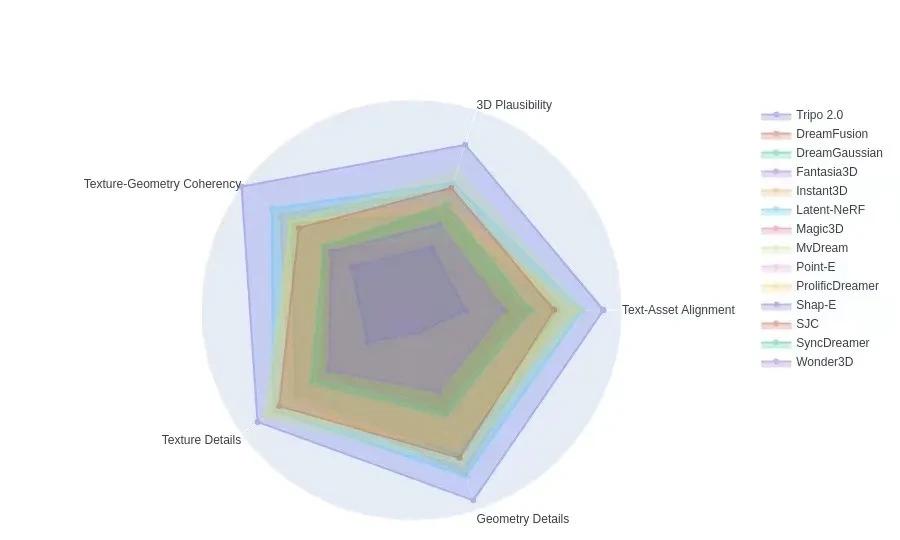
Previously, the team behind Tripo 2.0 collaborated with other groups to produce a wealth of academic achievements accepted by top conferences such as Siggraph, CVPR, ICLR, and ECCV. For example, Wonder3D generates consistent multi-view normal maps and corresponding color images through a cross-domain diffusion model, then rapidly reconstructs high-quality 3D geometry using a novel normal fusion algorithm. Compared to existing methods based on Score Distillation Sampling (SDS), Wonder3D shows significant improvements in efficiency, consistency, and detail, completing reconstruction in just 2-3 minutes.
Another example is TGS: Triplane Meets Gaussian Splatting, also accepted by CVPR 2024. This technology utilizes Transformer networks and a novel Triplane-Gaussian hybrid representation, making the reconstruction of 3D models from single images more efficient and precise. Those interested can refer to these details for further reading.
In short, Tripo 2.0 was not achieved overnight; it is backed by substantial technological accumulation. The burden now falls on enterprises to verify if this “all-around” performance holds up under commercial-grade constraints and copyright scrutiny.
What concerns me is that data provenance remains the critical blind spot in models trained on tens of millions of assets. I think hybrid architectures like DiT/U-Net offer robustness but increase inference complexity for deployment. My sense is enterprises must verify IP clearance before integrating these outputs into commercial pipelines.
The Scaling Law of the 3D World
Finally, let’s formally introduce the company behind Tripo 2.0.
VAST, founded in March last year, is an AI company focused on the research and development of large 3D models.
The company’s goal is “establish a UGC (User-Generated Content) platform for 3D by creating mass-market 3D content creation tools, making spatial-based 3D a key element for user experience, content expression, and enhancing new quality productive forces.”
Public records show that the company’s CEO and CTO both come from SenseTime:
Founder and CEO Song Yachen has led multiple zero-to-one AI projects at SenseTime and participated in the founding of MiniMax, one of the “Six Little Giants” of large models. CTO Liang Ding, who earned his bachelor’s, master’s, and doctoral degrees from Tsinghua University under Academician Dai Qionghai, previously served as the head of SenseTime’s General Model division.

In just a year and a half since its establishment, the company has been highly active.
First, earlier this year, it unveiled its first 3D large model, Tripo 1.0.
With billions of parameters, Tripo 1.0 can generate 3D mesh models from single images or text in just 8 seconds.

△ The classic “Avocado Armchair” in 3D modeling, generated by Tripo 1.0
Within six months of launch, global users had generated over 5 million 3D models using Tripo 1.0.
What does 5 million mean? It is approximately equal to the sum of the world’s top three largest 3D model databases.

In early March this year, VAST partnered with Stability AI, the team behind Stable Diffusion, to jointly release an open-source 3D foundation model called TripoSR.
Because it achieved the feat of “generating a 3D model from a single image in 0.5 seconds,” it has become highly popular in the open-source community for 3D generation, garnering 4.3k stars on GitHub to date.

Now, Tripo 2.0 has been released and is available for online use.
Thanks to the performance improvements brought by the 3D Scaling Law, the time span between these three updates of Tripo was only nine months.
It offers both speed and quality, earning recognition from within and outside the industry.
To cite a recent piece of news: Not long ago, Roblox, the world’s largest online game development platform, announced its entry into AI 3D generation. However, to date, Tripo remains the most popular and handy 3D modeling tool among Roblox players.

Where will VAST take Tripo next?
The answer we found is that, at least technically, VAST will continue to pursue the research on the Scaling Law of 3D Generative AI, exploring the fundamental principles relating model scale, data volume, and generation quality, while seeking scalable paradigms for data, representations, and model architectures.
It aims not only to push the boundaries of 3D generative AI but also to continuously explore more holistic (Holistic) 3D generation.
This is quite promising.
After language models and video models brought a little shock to this world, people hope that the 3D generation track will nurture its own “ChatGPT moment.”
After all, the situation in 3D AI generation is relatively unique compared to other AI tracks. Not only is post-generation manual editing technically difficult, but if the model’s performance is poor, trying to achieve satisfaction by simply increasing the number of attempts (drawing cards) is less effective than drawing it yourself (just kidding).
Fortunately, the 3D generation industry lives up to expectations and continues to move forward—
Looking back at the past two years, especially from late 2023 to 2024, 3D generation technology has developed rapidly.
It has improved in both effect and speed, achieving characteristics such as “high efficiency, low co
What concerns me is that vAST’s rapid iteration cycle signals intense competition for enterprise adoption standards. I think the SenseTime lineage suggests strong technical depth but potential governance blind spots. My sense is enterprises must verify IP ownership before integrating these models into commercial pipelines.
Tsinghua Team Breaks New Ground in AI 3D Generation with ‘3D Scaling Law’
As technology advances rapidly, the density of talent across the industry is also increasing. This shift isn’t just about raw compute; it’s about who can effectively govern and deploy these new capabilities. The burden of proof now lies with teams to demonstrate that their models are not only novel but compliant and safe for enterprise integration.
What concerns me is that talent density alone does not guarantee governance maturity. I think enterprises must verify safety protocols before adopting 3D generation tools. My sense is “Scaling laws” need rigorous auditing, not just performance metrics.
Domestically, companies like VAST are represented by startups from globally renowned universities and research institutions. Looking abroad, AI godmother Fei-Fei Li’s first startup, the spatial intelligence company World Labs, is also focusing on the 3D generation world, announcing its long-term goal to build Large World Models (LWM) to perceive, generate, and interact with the 3D world.
Many hands make light work.
It can be said that due to clear progress in talent, technology, effects, and scenarios, the AI 3D generation track is gradually entering more people’s vision. However, as these tools move from research labs to production environments, accountability structures must keep pace with innovation.
And the breakthrough progress potentially brought by the 3D Scaling Law seems to already indicate the direction of the next focus area in the field of artificial intelligence. We need to watch how this “law” translates into regulatory compliance and data provenance standards.
Comments
Sign in to join the discussion and leave a comment.
Sign in with Google