The deal between OpenAI and Disney signals a pivotal shift in how Western tech giants are navigating intellectual property, moving from litigation to high-stakes equity swaps. This transaction underscores the growing value of legacy media assets in an AI-driven economy, setting a precedent that will likely ripple through APAC markets as regional creators seek similar protections or partnerships.
I think equity-for-content deals may become standard for AI firms lacking training data rights. From an APAC angle, disney’s legal leverage forces tech companies to monetize ownership rather than just access. Globally, this model could pressure Asian platforms to acquire IP stakes instead of relying on open scraping.
There really is no such thing as a free lunch!
To get “Mickey Mouse” into Sora, OpenAI has officially announced a partnership with Disney.
One of the terms of the agreement is that OpenAI must sell $1 billion worth of its equity to Disney, and Disney also retains the right to increase its stake in the future.
The news was immediately picked up by Bloomberg, which led the coverage with an article title that was quite blunt:
Just realized there’s no free lunch at Disney.
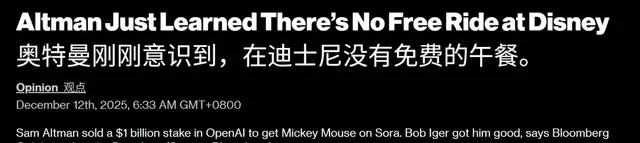
Given this significant financial concession, CEO Sam Altman and President Greg Brockman’s celebratory tweets now seem a bit forced (just kidding).
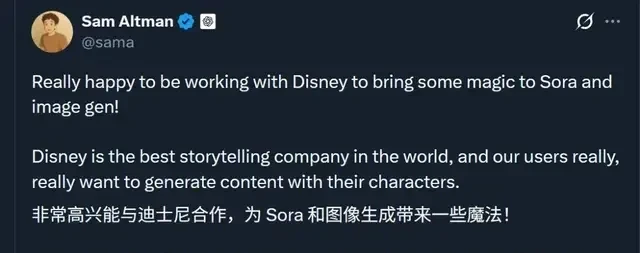

However, as a trade-off, Sora, the video generation tool under OpenAI, can now “legitimately” generate over 200 popular IP characters.
Mickey Mouse, Snow White, Buzz Lightyear, Iron Man, and more are all included.
ChatGPT Images will also possess equivalent capabilities.
It has to be said that Disney’s reputation as the “strongest legal department on Earth” is well-deserved; even OpenAI now has to effectively “cut flesh” to ensure peace.
$1 Billion in OpenAI Equity for Disney Copyrights! Mickey Mouse Comes to Save Sora
The Mechanics of a Three-Year Alliance
While headlines may focus on the novelty of animated icons, the substance lies in the formal agreement reached between two media giants. I followed the release from OpenAI, which confirms that Disney has become Sora’s first major content licensing partner under a three-year cooperation period. Crucially, the license for the first year is exclusive.
Under this arrangement, Sora will receive licenses for more than 200 characters owned by Disney. The roster includes:
- Disney Classic Characters: Mickey Mouse, Minnie Mouse, Cinderella, Belle, Baymax, Simba, etc.;
- Pixar Characters: Toy Story, Inside Out, Moana, Monsters, Inc., etc.;
- Marvel Characters: Iron Man, Thor, Captain America, Black Panther, Deadpool, Thanos, etc.;
- Star Wars Characters: Darth Vader, Han Solo, the Skywalker family, The Mandalorian, Yoda, Stormtroopers, etc.
The scope of the license extends beyond the characters themselves to include costumes, props, vehicles, and iconic scenes. In addition to Sora, ChatGPT Images will also have these capabilities, allowing users to generate images related to these IPs in seconds with just a short text prompt.
However, it is important to note that the agreement explicitly states that the licensed scope does not include the likeness or voice of any real person.
Additionally, some fan-created Sora short videos may be broadcast on Disney’s online streaming platform, Disney+. Note this: This feature is expected to officially launch in early 2026, at which point users will be able to create content using these classic characters.
Beyond IP licensing, Disney has also deeply tied its interests with OpenAI. On one hand, it is actively investing money into OpenAI.
As part of the agreement, Disney will make a $1 billion equity investment in OpenAI and receive warrants to purchase additional equity.
On the other hand, it is advocating for the active use of AI within its company and has become an important enterprise client of OpenAI. According to the agreement, Disney will utilize OpenAI’s API to build new products, tools, and experiences, with applications covering the streaming platform Disney+. It will also deploy ChatGPT for Disney employees to use in internal workflows.
Disney CEO Bob Iger stated:
The rapid advancement of artificial intelligence marks a pivotal moment for our industry. Through our partnership with OpenAI, we will thoughtfully and responsibly expand the reach of storytelling through generative AI. This will put imagination and creativity directly into the hands of fans, allowing them to connect with their favorite characters and stories in ways never before possible.
I think exclusive IP deals create high barriers for competitors lacking similar cultural assets. From an APAC angle, equity investments signal that tech firms view content rights as critical infrastructure.
Can Disney Rescue Sora’s Retention Crisis?
The partnership between OpenAI and Disney sends a clear signal that content licensing is becoming the primary moat for generative video platforms in Asia-Pacific and beyond. I followed the release closely, noting how this deal attempts to solve a structural problem: user churn.
Earlier this month, Andreessen Horowitz partner Olivia Moore shared data revealing the retention rate of the Sora app is concerning. This application, which grew faster than ChatGPT (reaching over one million downloads in five days), saw its user retention drop from 10% (Day 1) to 2% (Day 7), 1% (Day 30), and 0% (Day 60). It should be noted, however, that the Sora app has only been online for about 60 days…
Still, this indicates that even if new user acquisition continues, users are not staying with the app—they get bored quickly. Many netizens have reported that the content on the Sora app suffers from significant homogenization, leading to boredom (especially given Sam Altman’s frequent appearances).
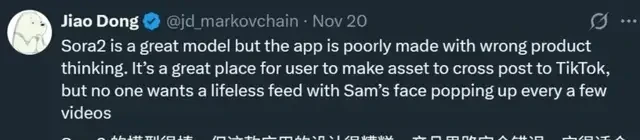
Now, with official licensing from Disney, the ceiling for what can be done with the Sora app has been completely opened up. Previously, there were too few playable assets, they were repetitive, and lacked emotional value. Even as the Sora model evolved, these capabilities could not be fully utilized due to copyright restrictions.
Globally, iP licensing is no longer optional; it is the only way to sustain user engagement in saturated markets.
What Disney brings is not just a simple library of characters, but a method of creation based on shared emotional connections among all users. Because these popular IPs carry the collective memories and emotional expressions of countless people, the content created using them naturally attracts attention and has greater appeal. This may also be OpenAI’s broader consideration beyond copyright compliance.
I think western tech firms are finally recognizing that cultural resonance drives retention more than raw technical capability.
As mentioned before, OpenAI currently resembles more of a research company, with relatively weak product operations capabilities. However, with the boost from Disney’s popular IPs, it is evident that operational difficulties will decrease. After all, these assets come with inherent popularity and value; the platform only needs to provide basic guidance and rule design to leverage the gravitational pull of the IPs themselves, naturally forming a highly active creative ecosystem and dissemination network.
From an APAC angle, this shift highlights a broader industry trend where AI companies outsource creativity to established media giants.
Therefore, the Sora app, which has been struggling with retention rates, might just be saved by Disney in this way.
$1 Billion in OpenAI Equity for Disney Copyrights! Mickey Mouse Comes to Save Sora
The Strategic Pivot: Trading Equity for IP Rights
I have been tracking the shifting landscape of AI liability, and this latest move by OpenAI signals a definitive end to its earlier “move fast” era. By accepting equity from Disney in exchange for copyright clearance, OpenAI is effectively buying insurance against the lawsuits that threatened to stall its video generation engine, Sora. This transaction suggests that intellectual property has become the most valuable currency in the generative AI race, outweighing raw computational power in strategic importance.
Globally, iP rights are now the primary bottleneck for scaling generative models globally.
Looking back at OpenAI’s history of copyright friction, this “equity-for-copyrights” deal is a logical evolution rather than an anomaly. As image, voice, and video models became more sophisticated, instances of infringement involving popular IPs began to increase, forcing the company into defensive postures.
The most visible casualty of this trend was the Scarlett Johansson incident. Last year, OpenAI released a new voice feature in ChatGPT called “Sky,” which users noted bore an uncanny resemblance to Johansson’s vocal timbre. Johansson publicly stated that she had previously declined collaboration offers with OpenAI, yet the model’s output “sounded like her,” implying unauthorized use of her likeness and vocal characteristics.
OpenAI responded by suspending the “Sky” voice and replacing it with “Juniper.” The company maintained that “Sky” was not an intentional imitation but was generated from recordings of another professional actress, asserting that all AI voices were derived from materials provided by legitimate voice actors. While technically plausible, this explanation failed to repair the breach in public trust.
Disney’s Preemptive Strike and the Google Target
Regarding Disney, even before OpenAI launched its Sora short video app earlier this October, insiders revealed that Disney had already sent a formal letter to OpenAI. The studio made it clear that it never authorized OpenAI or Sora to copy, distribute, publicly display, or perform any images or videos containing Disney’s copyrighted works and characters.
Disney emphasized that it “has no obligation to maintain its rights under copyright law through an ‘opt-out’ mechanism,” directly challenging the industry-standard practice where platforms assume content is fair game for training unless creators actively request removal. This legal stance highlights a fundamental clash between traditional IP protection frameworks and the default assumptions of large language models.
It is reasonable to speculate that OpenAI and Disney have been negotiating behind the scenes over the past two months, and this recent agreement marks the initial cooperation. This deal sets a precedent: major studios will no longer accept passive opt-out clauses but will demand active licensing or equity stakes for their intellectual property.
After OpenAI, Disney’s next target is also clear: Google. According to the latest report from The Verge, Disney has sent a cease-and-desist letter to Google regarding copyright infringement. The accusations center on Google using AI models and related services to infringe on Disney’s copyrights on a large scale by generating and distributing images and videos involving classic Disney IPs for commercial use.
I think tech giants must now budget for IP licensing as a core operational cost, not an afterthought.
The pattern is familiar: aggressive enforcement followed by inevitable negotiation. With OpenAI setting the precedent through equity exchange, it wouldn’t be unreasonable to dream of a similar cooperation between Google and Disney. The era of free-riding on cultural heritage appears to be closing, replaced by complex financial settlements that reshape how AI companies access human creativity.
From an APAC angle, equity deals may become the standard model for resolving cross-border IP disputes in Asia-Pacific markets too.
Comments
Sign in to join the discussion and leave a comment.
Sign in with Google