$360 Billion: OpenAI Launches ‘Stargate’ Plan with SoftBank and Oracle
The largest AI infrastructure project in history has launched, but for platform engineers, the headline isn’t just the money—it’s the latency and cost implications of building custom silicon at this scale. I read the filing, and what stood out to me is that OpenAI is moving from renting compute to owning it, a shift that changes the entire game for on-call teams managing model availability.
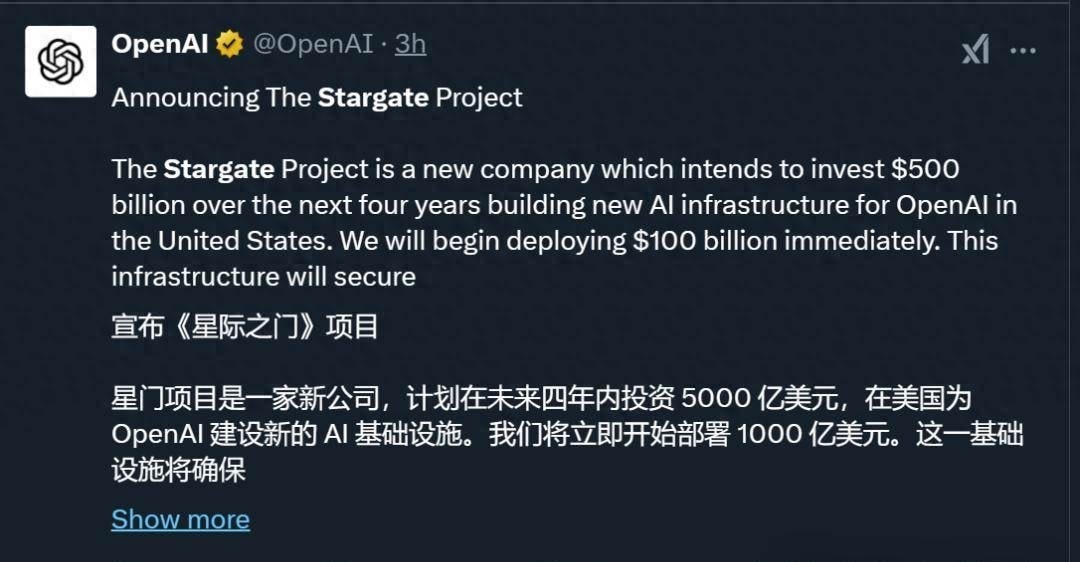
Not long ago, OpenAI officially announced the “Stargate Project” plan—
It will form a joint venture with SoftBank and Oracle to invest a total of $500 billion (approximately 3.64 trillion RMB) over the next four years to build multiple AI data centers in the United States.
The plan is launching immediately, with OpenAI preparing to invest an initial $100 billion right out of the gate.
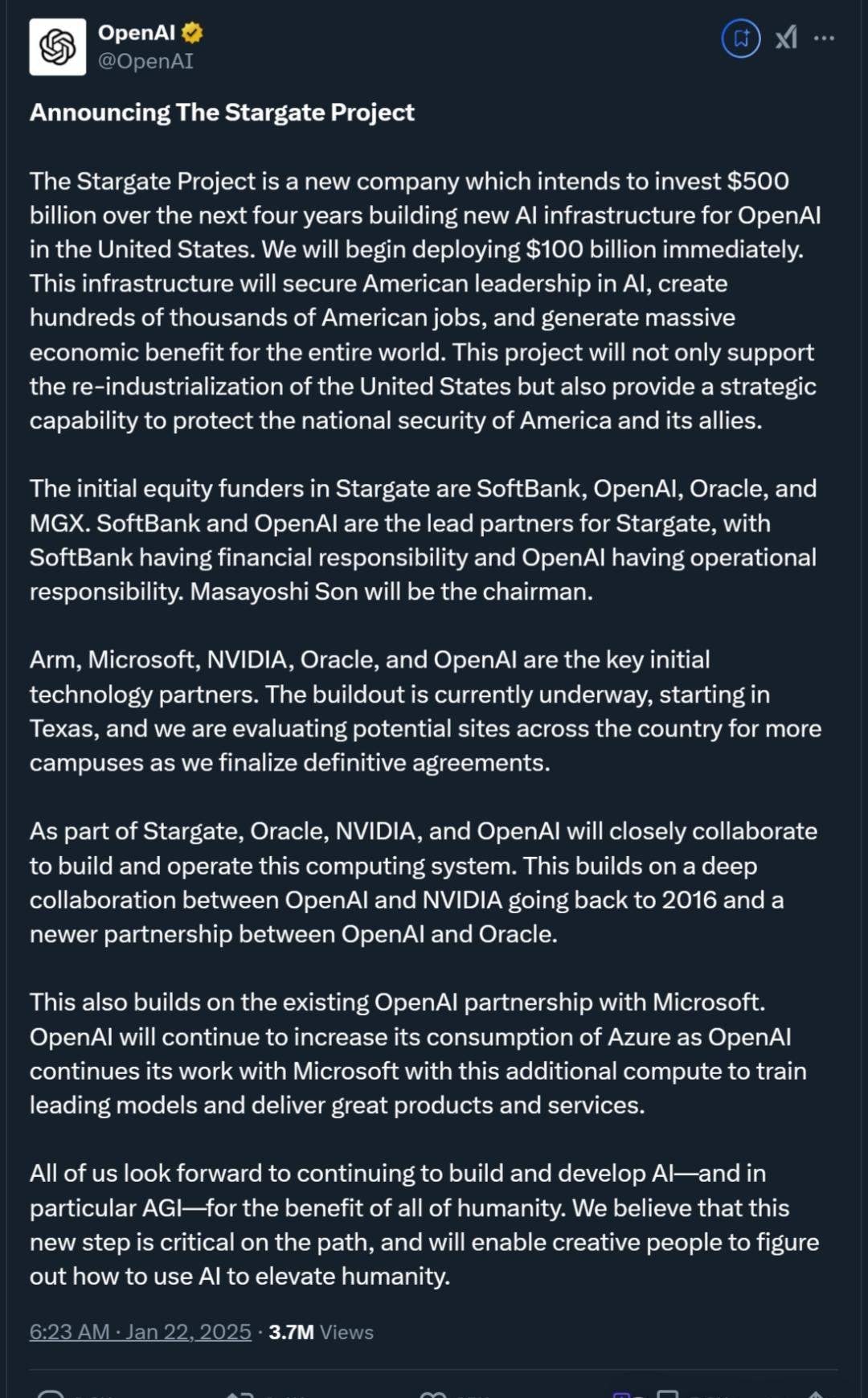
According to the announcement, this plan is led by OpenAI and SoftBank. OpenAI will handle operations, while SoftBank manages finances. SoftBank CEO Masayoshi Son will serve as chairman of the new joint venture, “The Stargate Project.”
Additionally, Arm, Microsoft, Nvidia, and Oracle will provide support as key technology partners. Construction is set to begin in Texas, before expanding to other states across the U.S.
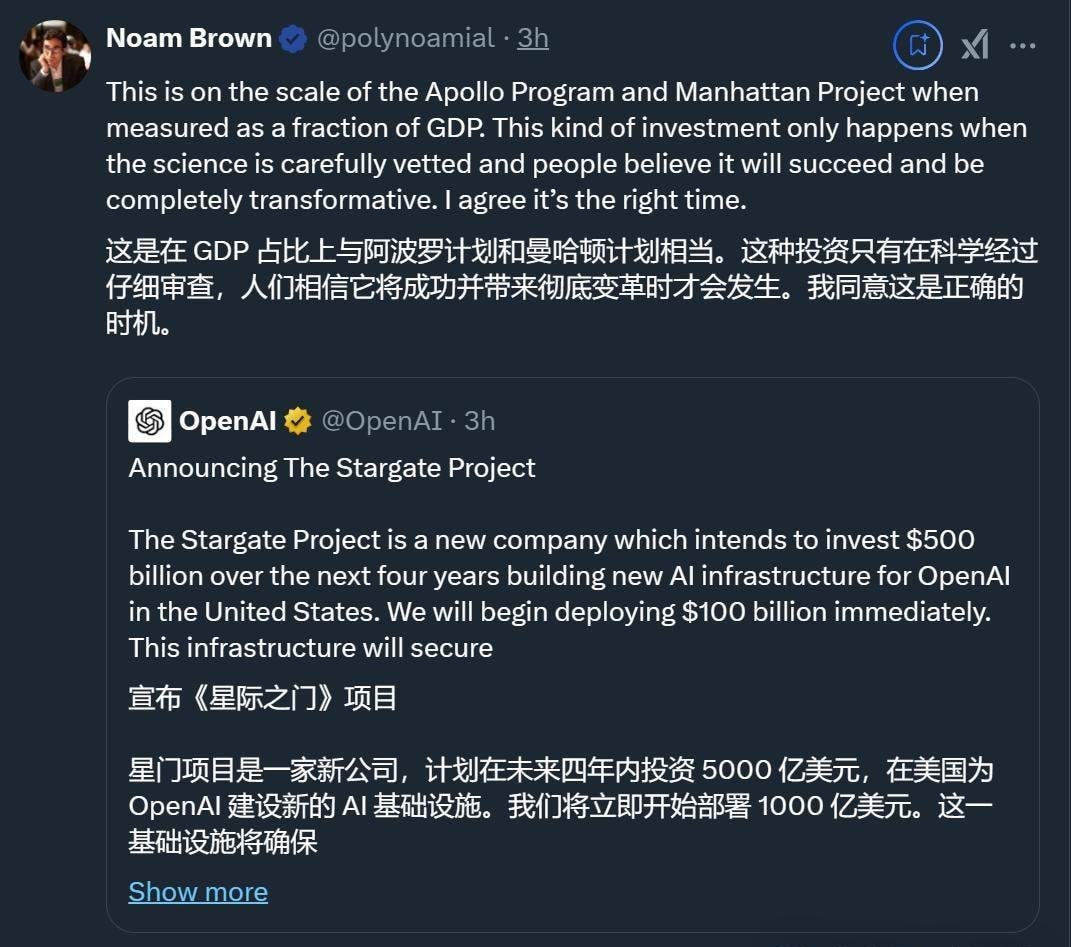
Regarding the scale of this project, according to OpenAI Senior Researcher Noam Brown:
Measured by its share of GDP, this scale is comparable to the Apollo moon landing program and the Manhattan Project.
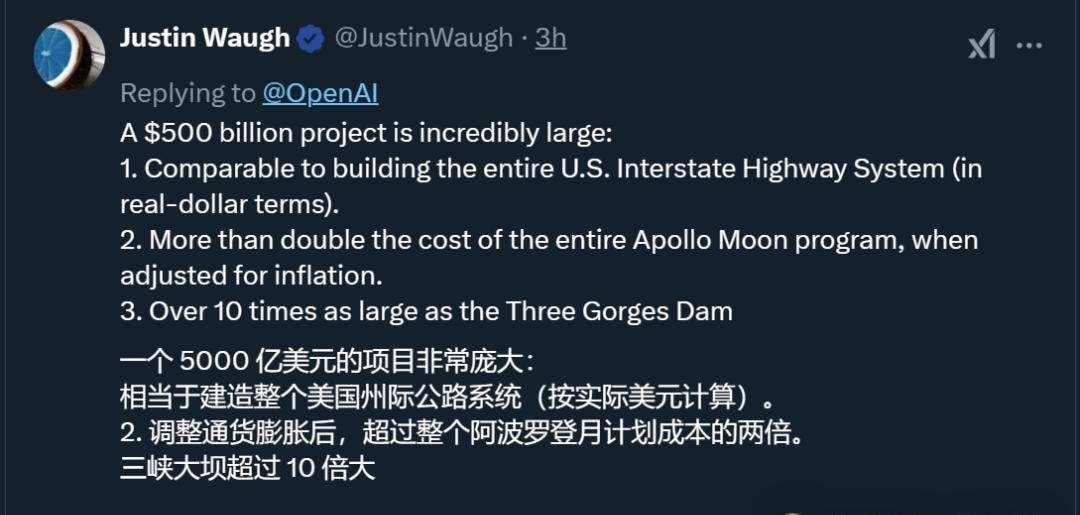
Others have gone so far as to say it is equivalent to building the entire U.S. interstate highway system.
Meanwhile, shortly after the news broke, OpenAI CEO Sam Altman quickly retweeted and posted a new tweet:
build monuments in the desert
Building monuments in the desert
Netizens in the comments section also began to joke around, as seen below:


Some even started watching the drama between Altman and Musk:
Altman previously tweeted, “No one is accelerating faster than me,” but later Musk set a record by building the world’s largest supercomputer in just 19 days.

Now, who knows what Musk is cooking up next? (doge emoji)~

At the same time as this news broke, it was reported that Microsoft is no longer OpenAI’s exclusive cloud service provider.
Combined with these developments, OpenAI appears to be seeking greater control over its underlying computing infrastructure.

What exactly is going on? Let’s take a look.
I read the filing, and the headline isn’t just marketing fluff—it’s a massive capital allocation shift. OpenAI is formally establishing “Stargate,” a new entity dedicated to building AI infrastructure in the U.S., with a staggering $500 billion investment plan over four years. They are deploying $100 billion immediately.
In practice, this isn’t a lab demo; it’s industrial-scale infrastructure that will dominate cloud capacity for years. I think the immediate $100B deployment means we need to prepare for massive resource contention and pricing pressure now.
Oracle, Nvidia, and OpenAI to Collaborate Closely
The core of this announcement is the operational triad: Oracle, Nvidia, and OpenAI will work closely together to build and operate this computing system. This isn’t a loose partnership; it’s an integrated stack designed for scale. It builds on the deep cooperation between OpenAI and Nvidia since 2016, as well as their new strategic partnership with Oracle.
The initial equity funders are SoftBank, OpenAI, Oracle, and MGX (the Middle East AI Fund). SoftBank and OpenAI are the lead partners, with SoftBank handling finance and OpenAI managing operations. Masayoshi Son will serve as chairman. This financial structure suggests a heavy reliance on debt and equity markets to sustain this pace of build-out.
Operationally, with SoftBank financing and OpenAI operating, expect aggressive uptime SLAs but also potential vendor lock-in for downstream consumers. In practice, the Nvidia integration since 2016 means the hardware stack is already mature; we’re just scaling it up by an order of magnitude.
Construction has already started in Texas, with additional campuses being evaluated nationwide as agreements are finalized. This physical footprint is critical because AI inference and training latency are bound by geography and power availability. The project aims to ensure U.S. leadership in AI, create hundreds of thousands of American jobs, and provide strategic national security capabilities for the U.S. and its allies.
Microsoft remains a key player here. As OpenAI continues to collaborate with Microsoft to leverage additional compute power for training leading models, it will continue to increase its usage of Azure. This ensures that while Stargate handles the heavy lifting of new infrastructure, existing Azure capacity is still being optimized for model delivery.
The ultimate goal is clear: building and developing AI—particularly Artificial General Intelligence (AGI)—to benefit humanity. OpenAI believes this initiative is crucial on this path, enabling creative people to use AI to elevate society. But from an ops perspective, the immediate reality is a massive surge in demand for power, cooling, and silicon that will ripple through every layer of the stack.
Microsoft’s Exclusive Cloud Monopoly Is Over
I read the filing, and the headline isn’t just about OpenAI’s $360 billion Stargate plan; it’s about Microsoft losing its exclusive cloud status. This shift from a closed loop to an open market changes how we think about infrastructure procurement for AI workloads. The project name recalls their collaboration last year, where The Information reported plans for a supercomputer costing up to $100 billion.
The cost was estimated at up to $100 billion, 100 times the cost of the largest data centers currently in operation. Its power consumption would be enormous, requiring 5,000 megawatts of electricity.
The original cooperation was split into five phases. Phase four involves a smaller $10 billion supercomputer expected online by 2026. Phase five follows later, aiming for full scale by 2030 once model breakthroughs occur. Details on subsequent implementation remain unclear, and it’s uncertain if this new Stargate Project links to previous efforts.

Microsoft is also investing $80 billion in fiscal year 2025 for AI data centers. Their blog post admits success depends on “new partnerships built upon massive infrastructure investments.” This admission signals that even the biggest player can’t scale alone.
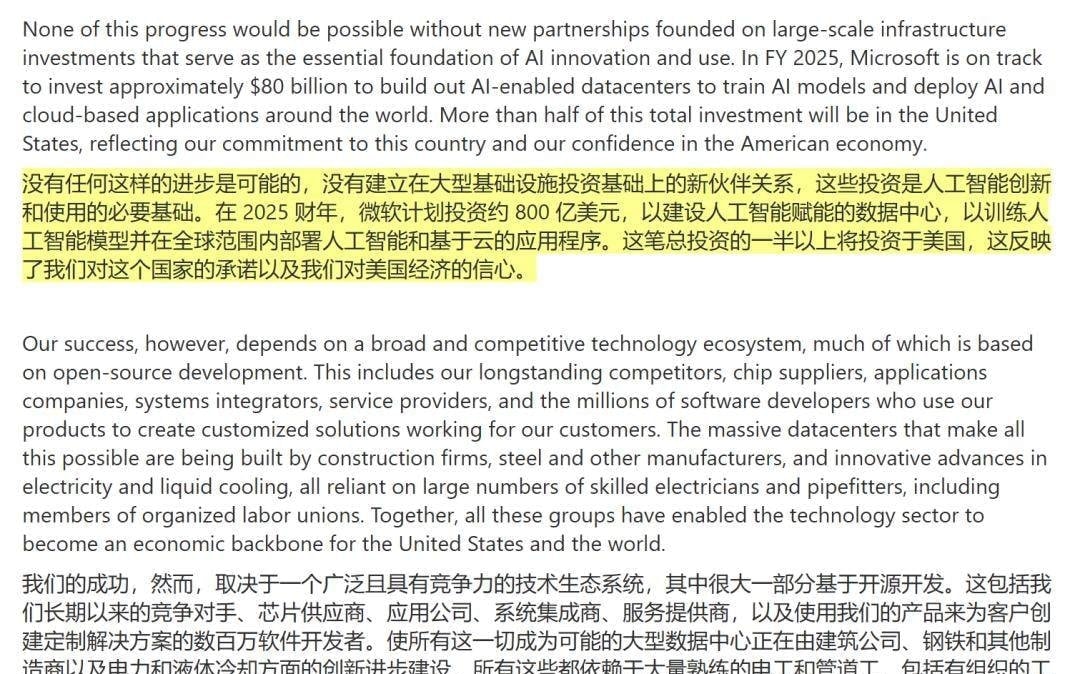
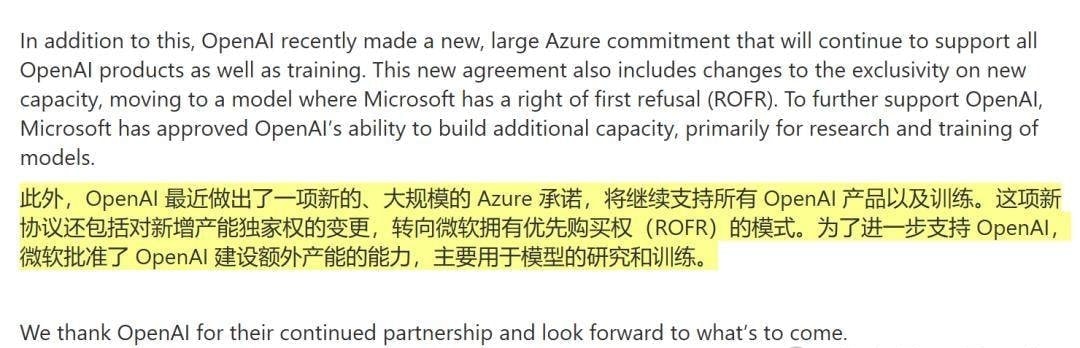
However, as OpenAI announced this plan, Microsoft lost its exclusive cloud provider status. A recent announcement confirms changes to their agreement:
It is no longer the exclusive cloud service provider for OpenAI, but it retains a “Right of First Refusal” (ROFR) on OpenAI’s new cloud service agreements.
In other words, if Microsoft cannot meet the demand, OpenAI can seek support from other cloud service providers. This breaks the previous lock-in and introduces multi-cloud complexity for ops teams managing these workloads.
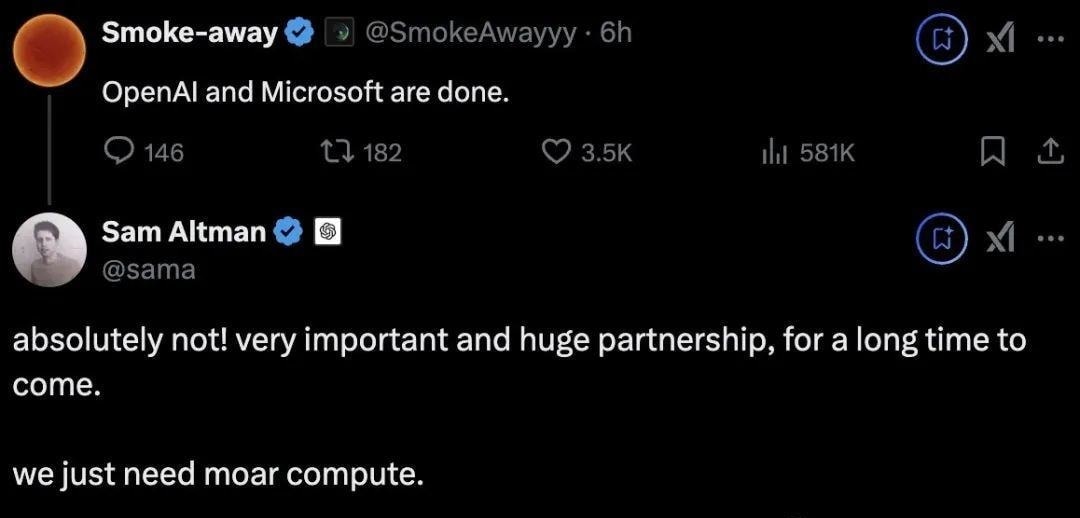
Netizens speculated this meant a complete breakdown in the relationship. Altman quickly debunked these rumors:
Absolutely not! … We just need more compute power.
I think multi-cloud is harder to manage but prevents vendor lock-in risks. I prefer flexibility over exclusive contracts for critical infrastructure.
The top-voted comment offered a sharp critique, highlighting the skepticism around these massive capital expenditures.

Comments
Sign in to join the discussion and leave a comment.
Sign in with Google