Apple’s $75 billion market cap evaporated in six minutes. This isn’t just a Silicon Valley glitch; it signals how global capital now prices AI readiness against legacy hardware cycles.
Apple’s Market Cap Plunges $75 Billion in 6 Minutes: What Was Announced at the Launch?
Market Cap Plummets by $75 Billion in Just Six Minutes Following Apple’s Event!
What caused investors to collectively lose faith in Apple’s latest product launch?
Ahem, the “culprit” is once again: Siri.

I followed the keynote closely, and even before this year’s WWDC conference, users and investors had high hopes for Siri updates. However, shortly after the keynote began, Craig Federighi, Apple’s Senior Vice President of Software Engineering, awkwardly announced that these updates might be delayed until next year.
Almost immediately following this announcement, Apple’s stock price dropped by more than 2.5%, falling from approximately $206 to below $201, representing a market capitalization loss of $75 billion (approximately RMB 538.58 billion).
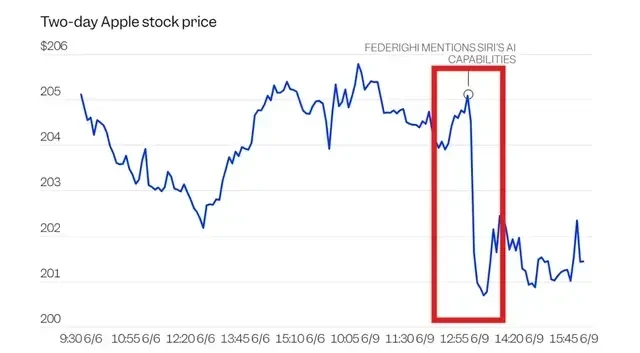
I think delaying core AI features signals to global markets that Apple prioritizes polish over speed. This hesitation may cost them enterprise adoption in Asia-Pacific regions moving fast on LLMs.
In fact, the main highlights of this year’s Apple keynote can be summarized in three aspects:
- A new “Liquid Glass” design language, touted as the “largest design update to date”;
- Regarding AI, beyond opening up its on-device models, Apple focused more on integrating third-party models and introducing a series of developer tools;
- Feature updates across all operating systems, including iOS and macOS, signaling a return to focusing on user experience.
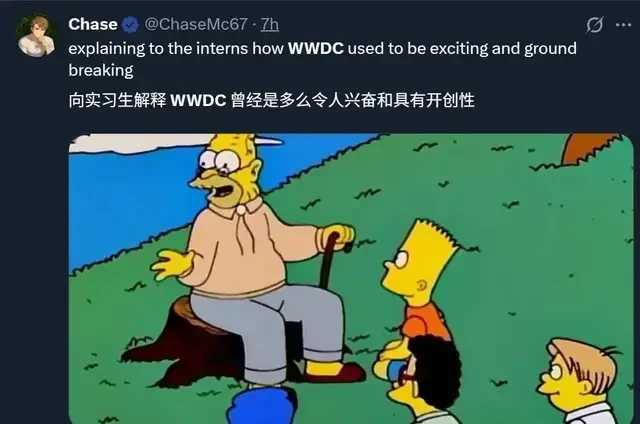
Judging solely from the perspective of AI, Apple’s moves were heavily criticized by netizens for being “too slow.”
Furthermore, Professor Ethan Mollick of the Wharton School observed that Apple’s actions are going in the opposite direction of other major tech companies:
Apple is doubling down on traditional user interfaces while neglecting AI.
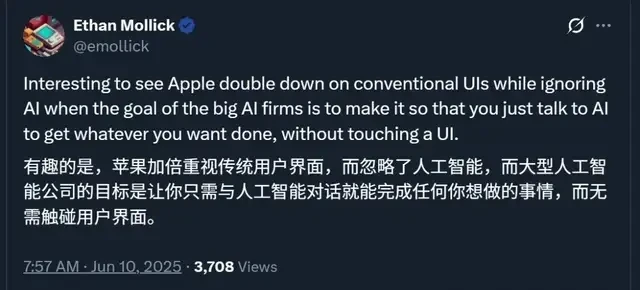
From an APAC angle, competitors are standardizing cloud-AI hybrids; Apple’s isolationist approach risks fragmenting the developer ecosystem. I see this as a strategic misstep in an interconnected APAC supply chain.
So, what exactly were the AI updates announced at this year’s WWDC?
Built-in ChatGPT Model and Developer Tools
I watched the market react with a sharp $75 billion plunge in just six minutes. The core of this volatility lies in Apple’s new developer toolkit, Xcode 26, which now integrates OpenAI’s ChatGPT model directly into the workflow.
This integration allows developers to weave AI into coding, testing, documentation, and bug fixing without forcing users to create separate accounts. Paid ChatGPT subscribers can link their accounts to bypass standard usage limits, a move that signals Apple’s pragmatic approach to adopting existing infrastructure rather than building from scratch.
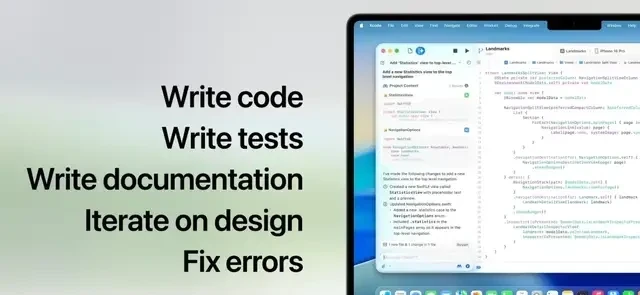
Beyond third-party models, Apple introduced the Foundation Models framework to let developers embed its own AI capabilities into their apps. The official statement notes that this framework natively supports Swift; a developer needs only three lines of code to access on-device models. It also includes generative AI features and tool-calling support, significantly lowering the barrier for integrating generation capabilities into existing software.
The framework is currently available for testing through the Apple Developer Program (developer.apple.com), with a public beta scheduled for next month via the Apple Beta Software Program (beta.apple.com).
Apple also rolled out broad updates across its operating systems, including:
- System-level real-time translation across apps;
- Visual intelligence enabling system-wide cross-app AI visual search;
- macOS integration with iPhone mirroring for checking orders and answering calls, alongside AI-customized shortcuts.
Globally, apple’s reliance on third-party APIs highlights a strategic gap in proprietary large language model development. This approach may slow innovation but reduces immediate technical risk. I see this as a defensive play to maintain ecosystem relevance rather than lead it.
The Visual Intelligence update stands out for its practical application. Similar to photo search but enhanced with AI, it lets users screenshot an app to identify objects and perform searches. It can also detect task events on-screen, suggesting calendar additions and extracting details like date, time, and location upon user approval.
Despite these features, investors remained unconvinced. The market’s reaction suggests that incremental updates are no longer sufficient to drive growth in the AI era.
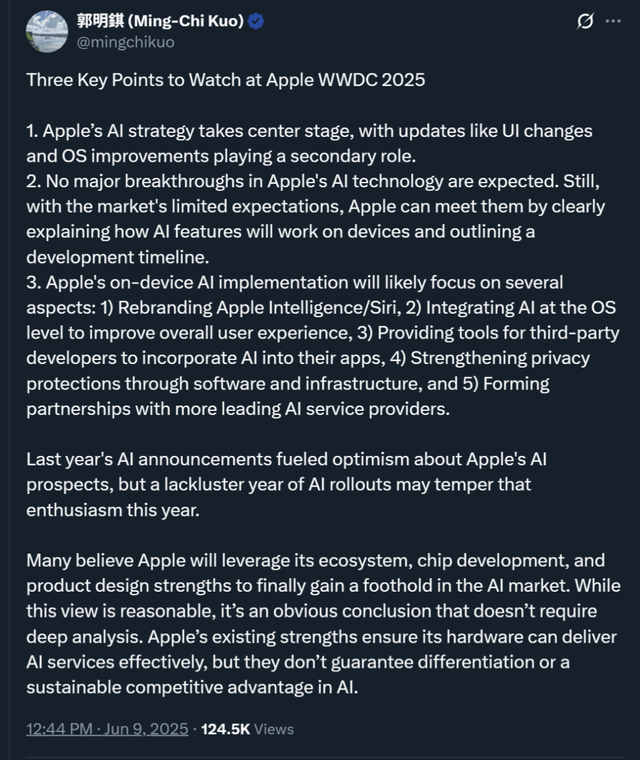
Renowned analyst Ming-Chi Kuo summarized the event with three key points. First, Apple’s AI strategy is central, while UI and OS improvements are secondary. Second, major technological breakthroughs are not expected; instead, success depends on clearly explaining how features work on-device and providing clear development timelines. Third, potential actions include integrating AI at the OS level, providing tools for third-party developers, and partnering with leading AI service providers.
I think the market penalizes ambiguity in AI roadmaps more than it rewards cautious integration. Apple’s transparency about limitations is a necessary step to rebuild investor confidence. I note that this strategy mirrors broader industry trends toward pragmatic, rather than revolutionary, AI adoption.
In short, facing the reality of falling behind competitors, Apple finds itself “willing but unable” to act independently. This has prompted it to consider collaborations with third parties like OpenAI, a shift from its historical preference for vertical integration.
One More Thing
The cultural reception was equally telling. Netizens quickly used AI to remix the keynote, mocking Apple’s slow progress in less than two minutes. In one viral edit, the original segment on emoji blending was replaced with a voiceover stating: “When you are the last major tech company doing things related to AI.”
From an APAC angle, this rapid public mockery underscores the high expectations for AI leadership in the global tech sector. It reflects a broader sentiment that incumbents must accelerate innovation to avoid irrelevance. I view this as a warning sign for other legacy tech firms facing similar pressures.
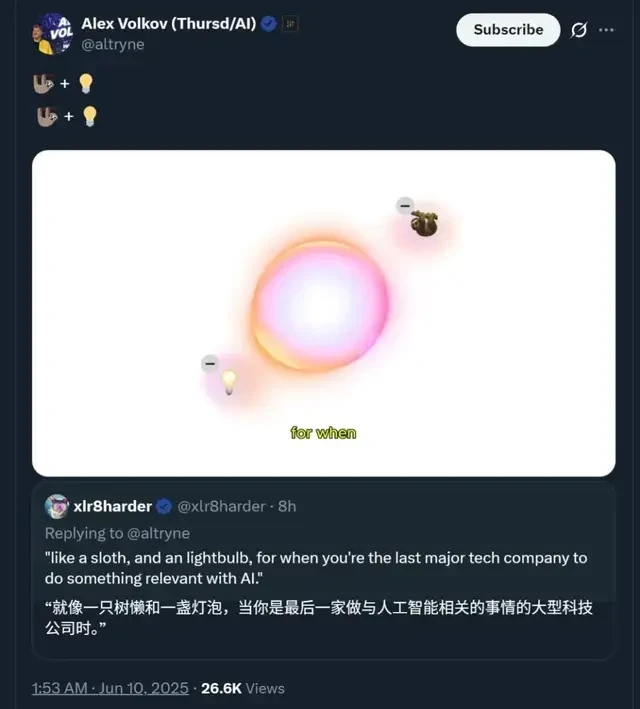
The ease with which these edits were created highlights the democratization of AI tools, even as Apple struggles to position itself as a leader in the space.
Comments
Sign in to join the discussion and leave a comment.
Sign in with Google