I read the release for what it claims to be: a living assistant that lives on your machine and talks directly to your files, calendar, and email without manual uploads. The pitch promises seamless integration across Slack, Teams, Outlook, Gmail, Salesforce, and Asana. During the demo, AWS VP Jigar Thakkar commanded Amazon Quick to schedule a 30-minute meeting with Manuj to brainstorm product strategy.
I’ve seen agents fail at basic calendar syncs; this demo glosses over permission hell. I think proactive PPT generation sounds great until it hallucinates client data from internal systems. In the field, enterprise-level agent operating models usually mean more overhead, not less.
This lobster is called Amazon Quick.
It is the kind of “living” assistant that resides on your computer, directly connecting to your local files, calendar, email, and various applications without requiring any manual file uploads (with authorization).
But most importantly, Amazon Quick has achieved ecosystem integration:
Whether you use Slack or Teams, Outlook or Gmail, Salesforce or Asana, it works seamlessly across all of them.
For example.
During the event, AWS Vice President Jigar Thakkar simply said to Amazon Quick:
Schedule a 30-minute meeting with Manuj to brainstorm product strategy.
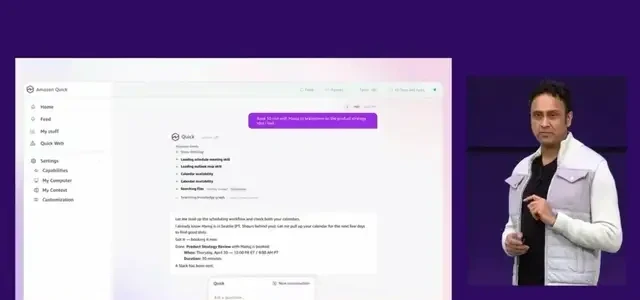
Amazon Quick instantly understood the project context, recognized colleague relationships, automatically checked calendars and time zones, sent out the meeting invitation, and even posted a Slack message (similar to DingTalk) for notification.
There was no need to switch between tabs or engage in tedious copy-pasting; everything was executed in one smooth flow.
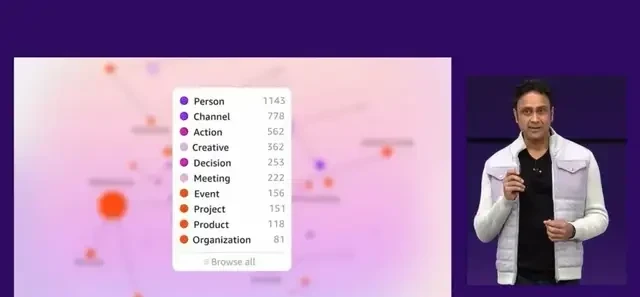
The reason Amazon Quick can do this is that it is backed by a knowledge graph that connects emails, Slack, CRM systems, calendars, local documents, and files.
In simple terms, it weaves people, projects, decisions, and actions into a living map of work.
Moreover, Amazon Quick is an proactive Agent.
For instance, if you have a meeting with a client in the afternoon, it will proactively remind you without any action on your part and prepare materials for you:
It conducts company and industry research, pulls customer case studies from internal systems, retrieves product roadmaps from local files, and overlays them with the client team’s briefs, emails, and Slack threads. Finally, it generates a PPT ready to be taken into the meeting.
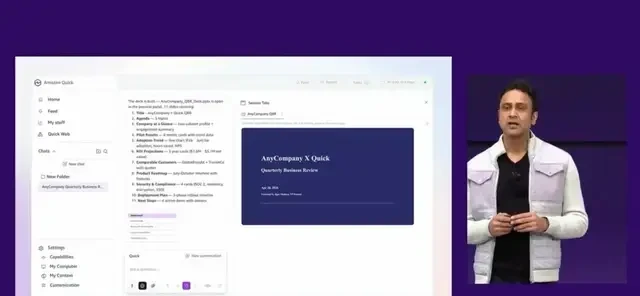
Just a few minutes—truly only a few minutes in total!
However, to be fair, AWS does not intend for Amazon Quick to merely be an efficiency tool. Based on Jigar Thakkar’s remarks, it aims to solve problems at three levels:
- Individual level: It helps schedule meetings, prepare briefs, and generate documents, emails, spreadsheets, and PPTs;
- Team level: It can create shared Spaces, consolidating workflows scattered across emails, shared drives, and approval systems into a single, continuously updated workspace;
- Enterprise level: When all employees work in this manner, Agents become part of the organizational operating model.
And this is merely the appetizer from AWS’s “What’s Next with AWS” press conference today.
Altman Stands by Cloud Despite Lawsuits
Sam Altman appeared in a pre-recorded video, largely because he is currently occupied fighting Elon Musk’s lawsuit in Oakland. It’s a convenient way to stay visible without being physically present for the Q&A.

The strategic pivot is the real story here. Just after OpenAI adjusted its partnership with Microsoft, it immediately turned to Amazon Web Services (AWS). This marks the first time AWS has integrated OpenAI’s strongest closed-source model, having previously hosted two open-source models last August. AWS CEO Matt Garman took the stage to announce:
This is a request our customers have been making of us for a long time.
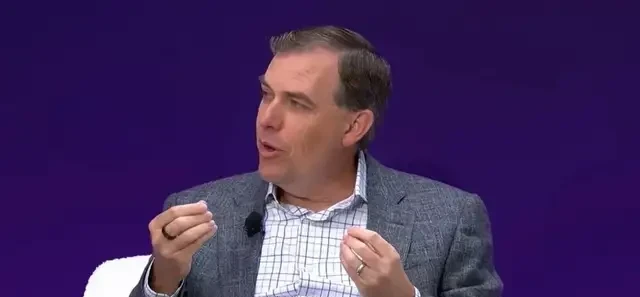
Altman’s video message framed this as a continuation of AWS’s legacy:
Amazon Web Services redefined cloud computing, freeing developers from worrying about infrastructure; today, our collaboration with AWS aims to do the same thing in the Agentic AI era.

What I watch for is marketing spin doesn’t pay for the GPU clusters running these models. I’ve seen how slow enterprise security onboarding actually is in practice.
This “handshake” delivers three impacts, all currently in limited preview:
First, OpenAI’s latest frontier models are now on Amazon Bedrock. Starting today, customers can invoke GPT-5.4 directly, with access to GPT-5.5 coming in the next few weeks. This consolidates evaluation and deployment for models from OpenAI, Anthropic, Meta, Mistral, and AWS into a single console. Crucially, these models inherit AWS enterprise-grade security: IAM-based access, PrivateLink connectivity, encryption, and CloudTrail logging. Data stays within the VPC, theoretically removing the need to reconfigure infrastructure or learn new security protocols.
Secondly, Codex has landed on Bedrock. AWS reports over 4 million weekly users for Codex. Integration allows enterprise teams to use AWS credentials for inference via the CLI, desktop app, and VS Code extension. Garman highlighted how this shifts software development: bug fixes that used to take weeks can now be patched within 20 minutes after detection on social channels.
I think twenty-minute patch cycles sound great until you hit a regression in production. In the field, we need to see the actual cost per token before trusting these speed claims.
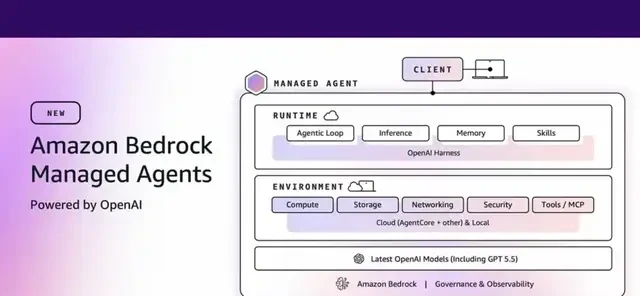
Finally, AWS introduced Bedrock Managed Agents, powered by OpenAI. The premise is that robust agents require more than just smart models; they need production-grade infrastructure like cross-session memory, identity permissions, and audit logs. This offering aims to combine OpenAI’s frontier capabilities with AWS’s global security ecosystem, allowing customers to deploy agents faster without building the underlying infrastructure from scratch.
The Connect Pivot: From Cloud Phone System to Agentic Suite
I’ve watched the cloud computing sector pivot from raw infrastructure to packaged business logic, and Amazon’s latest move with Amazon Connect is a textbook example. If Quick is your desktop assistant and Bedrock is the engine room, then what AWS just released feels less like a software update and more like they are wrapping decades of operational experience into four distinct Agentic AI solutions.
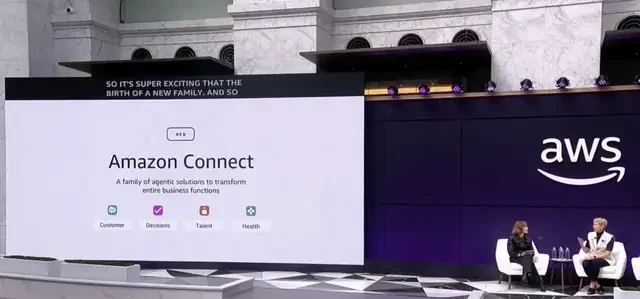
Today, Amazon Connect has expanded from a single product into four Agentic AI solutions:
- Amazon Connect Decisions
- Amazon Connect Talent
- Amazon Connect Customer
- Amazon Connect Health
These target supply chain, recruitment, customer experience, and healthcare, respectively.
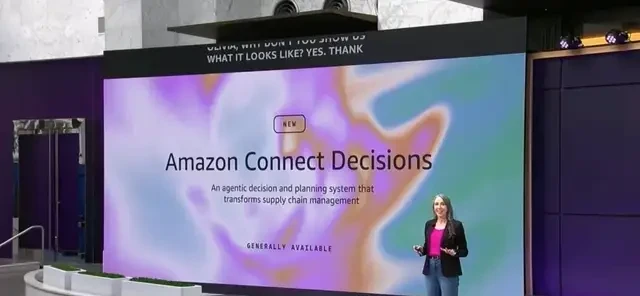
Let’s look at Amazon Connect Decisions first.
This is an AI solution for supply chain decision-making. AWS found that supply chain disruptions often cost enterprises over two weeks to resolve, with teams manually collecting data across fragmented systems, spreadsheets, and emails.
Connect Decisions is built on more than 25 specialized supply chain tools, 30 years of Amazon’s operational science, and the Amazon Supply Chain Optimization Technologies (SCOT) foundation model.
The Agent understands business context, sets appropriate forecasts for different products, proactively asks about information that affects forecasts such as promotions or holidays, incorporates these factors into results, and compresses thousands of alerts into a few items requiring human judgment.
What I watch for is supply chain agents that compress alerts are useful until they miss a critical nuance in global logistics. I’d rather see the unit economics of these SCOT models than hear about their forecasting capabilities. I think compressing thousands of alerts is only helpful if the remaining few don’t require a PhD to interpret.
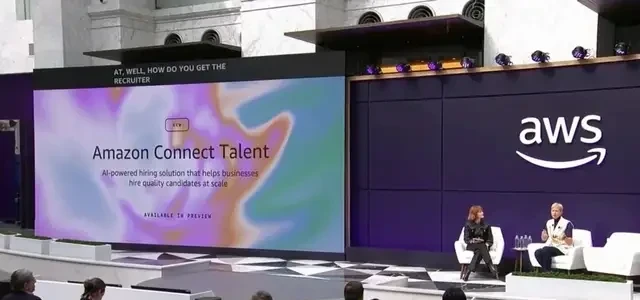
Next is Amazon Connect Talent.
It targets large-scale recruitment. Drawing from Amazon’s own experience, which hired 250,000 seasonal workers during the 2025 peak season, Connect Talent starts with existing job descriptions and uses AI Agents to analyze role requirements, generate interview plans, key competency areas, structured questions, and evaluation criteria. After recruiters approve them, the system can automatically invite candidates for voice interviews at their convenience.
For candidates, this means no more repeatedly coordinating schedules for phone screenings; for recruiters, opening the system the next day reveals not a pile of unprocessed resumes, but anonymous competency scores, full transcripts, and notes.
In the field, automated voice interviews for seasonal labor feel like efficiency theater rather than genuine hiring improvement. What I watch for is anonymous competency scores are only as good as the biased data used to train them.
Amazon Connect Customer is an upgraded version of the original Amazon Connect customer service system.
It continues to serve voice, chat, and digital channels for customer experience but adds configuration capabilities that allow organizations to set up conversational AI experiences in weeks rather than months, without requiring strong technical backgrounds. Business teams can directly design and deploy complex customer processes such as authentication, payment processing, personalized recommendations, and problem resolution.

Finally, there is Amazon Connect Health.
It targets the healthcare sector, focusing on automating administrative tasks such as appointments and documentation, allowing medical staff to spend more time with patients.
I think healthcare AI that promises more patient time often delivers more billing errors instead. In the field, automating documentation is easy; ensuring HIPAA compliance in real-time voice transcripts is the hard part.
In addition, AWS introduced an interesting product philosophy this time: Humorphism (human-centric design).
Colleen Aubrey, Senior Vice President of Applied AI Solutions, explained:
Past software interfaces were Skeuomorphic, bringing real-world folders onto the screen; in the Agent era, we need to align with the dynamics of human interaction. When you are stuck, teammates help; when you are focused, teammates wait. This is what Agents should look like.

What Is This Press Conference Trying to Say?
I read the “What’s Next with AWS” keynote, and it boils down to a single, aggressive thesis: Agents have become a new enterprise operating system. Julia White put it plainly, but I’m looking for the unit economics behind that claim.
What I watch for is hype cycles usually crash when you try to bill for agent hours instead of compute seconds.
Matt Garman is pushing the “Agentic Era” narrative hard, claiming we are entering a world with billions of agents. He says momentum isn’t just maintaining—it’s accelerating faster than anticipated across nearly every industry. But he also dropped a crucial caveat: enterprises cannot simply hand over existing processes to agents unchanged.
I think if you automate a broken workflow, you just get broken results at scale.
This mirrors the early cloud migration days. Companies lifted their on-prem data centers into the cloud without changing architecture, only realizing later that true value came from horizontal scaling and serverless computing. Agents are no different. Using AI to merely execute old workflows might squeeze out some efficiency, but it won’t deliver a five- or ten-fold transformation in user experience. The real opportunity requires redesigning applications from the ground up.
In the field, most “AI-native” apps are just wrappers around legacy SQL databases right now.
The core question here is how enterprises fundamentally change operations when AI evolves beyond answering questions—capable of understanding context, invoking tools, maintaining continuous memory, and proactively executing tasks? Amazon Web Services’ answer is to integrate AI into desktops, model platforms, industry-specific workflows, and the daily fabric of enterprise operations.
What I watch for is integrating agents into legacy ERP systems usually means building a layer of middleware that breaks in production.
Whether this “lobster”—a metaphor for a potentially delicious but initially unappealing concept—proves its worth depends on actual enterprise implementation. Judging by this launch event alone, the cloud computing giant is no longer content with merely providing the basic utilities of the AI era—power and water. It aims to become the new workstation of the Agent age.
I’d rather pay for reliable infrastructure than subscribe to a promise of autonomous labor.
Comments
Sign in to join the discussion and leave a comment.
Sign in with Google