I think aI coding tools lower the barrier to entry but shift the burden to complex deployment workflows. For creators, developers are losing time configuring infrastructure instead of building unique application logic. On licensing, the industry needs automated, code-driven deployment to truly democratize software creation.
The narrative around artificial intelligence in software development is shifting rapidly. We used to believe that writing syntax was the primary hurdle for creators and engineers alike. Now, a prominent figure in the AI coding community, Karpasi, has publicly declared that this assumption is outdated. The real friction isn’t in generating logic; it’s in getting that logic to run reliably in production environments.
I’ve really come to realize that writing code isn’t the hard part anymore; the real challenge is setting up all these deployment services!!
These words from Karpasi highlight a growing pain point in the creative stack: while AI can draft functions and classes with impressive speed, it often leaves developers stranded when it comes to infrastructure. The bottleneck has moved from generation to orchestration.
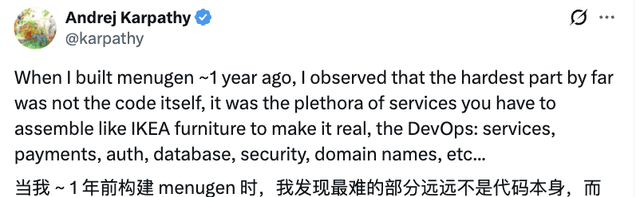
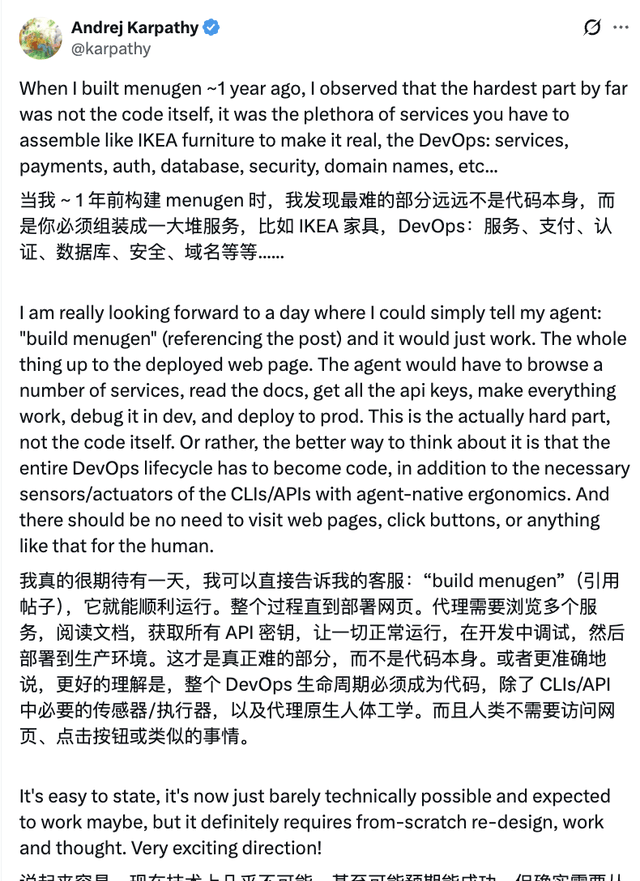
What stood out to me in Karpasi’s analysis was the specific call for abstraction. The argument isn’t just that deployment is hard, but that it shouldn’t be manual at all. The ideal state, according to this view, is a development process where application products are invoked directly by code, requiring zero manual configuration from humans. This suggests a future where the “ops” layer is entirely invisible to the creator.

Following these remarks, the developer community in the comments section echoed similar frustrations. They shared various deployment pitfalls encountered with AI-generated code, ranging from environment mismatches to dependency conflicts. The difficulties of deploying AI-generated code have clearly become a widely recognized major problem for programmers, signaling that the next frontier for AI coding tools isn’t better syntax generation—it’s seamless, automated deployment.
The Deployment Trap: Why AI Coding Is a Mirage for Indie Makers
By Lin Mei Huang, Multimodal & Media AI Editor
The creative stack has shifted from “can I make it?” to “can I ship it?”, and the answer is increasingly no. While tools like Cursor and Claude have democratized code generation, they haven’t solved the fragmented reality of modern deployment. For creators, this isn’t just a technical hurdle; it’s a new form of labor friction that threatens to bury good ideas under configuration debt.
The Illusion of Completion: Coding vs. Shipping
I followed Karpasi’s journey with MenuGen, a tool born from simple frustration: he was tired of staring at text-only menus and wasting time searching for dish images online. His solution? Build an AI-powered menu image generator. And honestly, the output worked. You feed it text; it spits out visual menus.

The development phase was a dream. Using Cursor + Claude, Karpasi fed requirements into Claude 3.7, which rapidly assembled the React frontend. The speed was absurdly fast, leading him to believe he had completed 80% of the work. Reality, however, slapped him hard. When it came time to deploy, he realized that coding was barely 20% of the battle.
I think aI accelerates prototyping but leaves creators stranded in deployment limbo. For creators, the gap between code generation and live functionality is widening, not shrinking.
The API Minefield: Outdated Docs and Rate Limits
The trauma began with the first integration: calling the OpenAI API for OCR recognition. It sounds simple—get an API key—but Karpasi hit a wall of outdated information. Claude kept providing obsolete model names and invocation methods. He had to manually cross-reference documentation, fixing errors bit by bit.
Once he finally got one call working, rate limiting kicked in: only a handful of requests every ten minutes. This wasn’t an edge case; it was the norm.
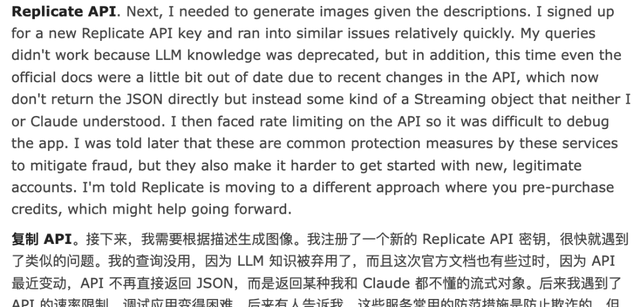
He then tried Replicate for image generation, falling into nearly identical traps. The LLMs provided outdated invocation methods, and APIs had shifted from JSON to streaming object formats that neither Karpasi nor Claude could parse correctly. After aligning interfaces, he hit rate limits again, making debugging nearly impossible.
On licensing, relying on AI for API integration is risky when documentation lags behind model updates. I think rate limits turn rapid prototyping into a slow, frustrating crawl.
The Launch Paradox: Accidental Public Exposure
The launch phase was even more chaotic. Karpasi struggled with account registrations and GitHub connections. Logs were flooded with linting errors that didn’t exist locally. After an hour of troubleshooting, he discovered a fundamental error: his API key was in .env.local, which isn’t committed to version control by default.
He manually entered environment variables into the Vercel backend. The result? Vercel generated a public link for a private repository. The product had been accidentally launched before it was ready.

Post-launch, the nightmare continued with authentication, payments, domains, and OAuth. Configuring multiple platforms back-to-back left him exhausted. The product itself was good, but the bitter struggle behind deployment configurations was real.
For creators, accidental public launches due to environment variable errors are a common, costly mistake. On licensing, the complexity of third-party integrations (OAuth, payments) outweighs the ease of code generation.
Kapasix Breaks Down: AI Coding Has No Barrier, But Deployment Is a Real Struggle
The creative stack is shifting again. While AI has demolished the barrier to entry for writing code, it has inadvertently erected a brick wall around deployment. For creators who just want to ship an idea, this transition from “vibe coding” to actual application launch is where the friction—and the frustration—truly begins.
Running demos locally with vibe coding is indeed enjoyable; but once it becomes a real application to launch, the entire process becomes extremely painful!!!
This sentiment led Karpasi (also referred to as Kapasix in some contexts) to a stark conclusion: It is indeed possible for someone with almost no web development background to build an application from scratch using vibe coding. It can be done, and it’s much faster than before; code is hardly the issue anymore.
I think vibe coding lowers the barrier to entry but raises the cost of ownership for non-technical creators. For creators, deployment friction forces solo creators into roles they didn’t sign up for: DevOps engineers. On licensing, when tools are built for AI, human creators bear the burden of debugging invisible configurations.
However, the problem arises when it comes to deployment, connecting services, and configuring environments, where progress frequently stalls and the experience collapses completely. As Karpasi notes, The issue isn’t with AI, but with the toolchain.
These deployment tools were originally designed for professional developers. Now that a single person paired with AI wants to run the entire workflow, bottlenecks are inevitable at the engineering pipeline stage.
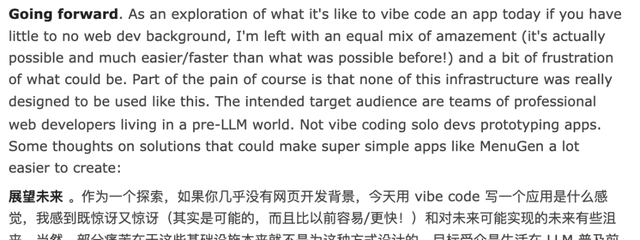
From this bumpy development experience, Karpasi derived some lessons and suggestions. In his view:
- Integrated platforms are crucial. Ideally, there should be products that package the entire deployment capability, allowing users to “open box and use” directly. (Agreed!)
- Current market development tools seem designed more for AI than for humans. The best approach is likely to let AI call and configure things itself.
- Rather than building complex configuration framework processes, simpler architectures are more efficient. Basic frontend + simple backend is actually better suited for rapid application development.
He believes that many applications don’t need to be built as complete products in the traditional sense. Applications shouldn’t be piled up from code; they should be generated with a single sentence.
Even though over a year has passed, Karpasi still feels emotional when talking about this project, saying:
Kapasix Breaks Down: AI Coding Has No Barrier, But Deployment Is a Real Struggle
The Second Half of AI Programming Begins to Compete on “Deployment Automation”
The creators who write the code are finally losing ground to the engineers who manage the infrastructure. I read through Karpasi’s recent reflections and saw that his frustration wasn’t abstract—it was triggered by Stripe Projects, a new tool from Patrick Collison, co-founder and CEO of Stripe, designed specifically to plug this deployment gap.
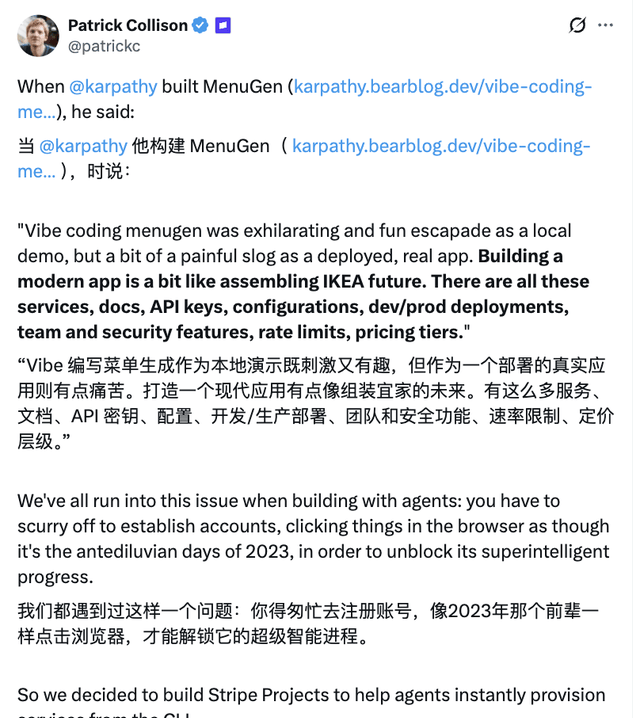
Stripe Projects aims to unify the development infrastructure. It allows developers or AI agents to handle tedious tasks like account registration, hosting, authentication, and billing with just a few commands. This aligns perfectly with Karpasi’s ideal vision for AI programming: where generation is instant, but deployment remains a friction point.
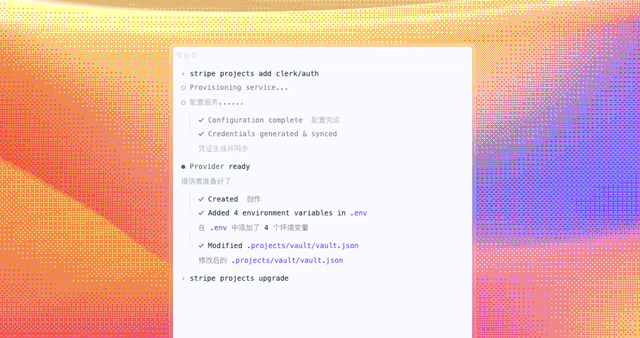
I think we are seeing a shift where deployment complexity becomes the new gatekeeper for independent creators.
Beyond Stripe, other products optimizing AI programming deployment have emerged. Take Firebase Studio, officially described as a tool that uses AI Agents to prototype, develop, test, iterate, and publish full-stack AI applications. It essentially tries to consolidate writing code, configuring backends, and launching into a single workspace.
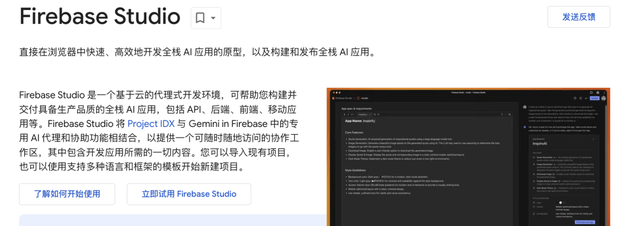
For creators, consolidating backend config into one workspace reduces context switching for solo developers.
Then there is Railway, which emphasizes an “open box and use” approach. It can already automatically connect multi-service templates and even link services together via environment variables, significantly reducing the need for manual user configuration.
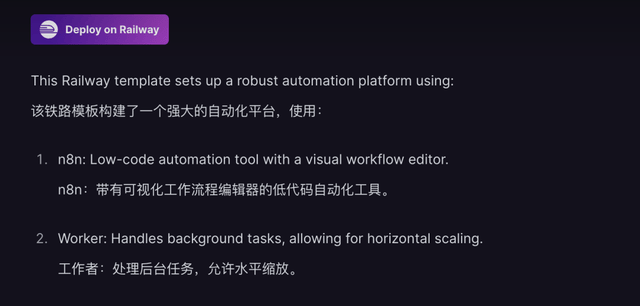
On licensing, automated service linking saves hours of DevOps work that creators shouldn’t have to do.
Looking at this landscape, AI programming feels surreal right now. On one side, Claude and Cursor generate frontend pages in minutes; on the other, API keys and various configuration hurdles deliver a series of blows, instantly bringing people back to reality.
The most intuitive example from the past few months has been OpenClaw. To get an AI lobster to build a development website, you first have to constantly debug that bug-prone system.

And set up APIs and other tedious configurations. If the project requires 24-hour operation, problems may multiply: if the terminal disconnects, the page crashes, forcing you to repeat the cycle of patching and fixing…
I think unreliable deployment pipelines punish creators who lack dedicated DevOps support.
So, Karpasi’s rant resonates with netizens for good reason.
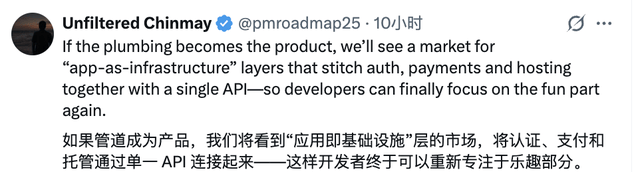
Anyway, let us eagerly anticipate the emergence of more, better, and easier-to-use products. Perhaps one day will come when we won’t even need to write prompts, achieving everything in one step via brain-computer interfaces??? (doge emoji)
What are your thoughts? Feel free to chat in the comments~
References
I read through the source material to understand how Kapasix is navigating the gap between code generation and real-world deployment.
- Vibe coding MenuGen — Work log of vibe coding menugen app
- MenuGen - AI Menu Image Generator — Upload a menu and get AI-generated images for each dish
- firebase.google — firebase.google.com/

Comments
Sign in to join the discussion and leave a comment.
Sign in with Google