I read the filing, and it confirms what I suspected: OpenAI is keeping its nonprofit soul while its for-profit body goes public benefit. The stage show always looks cleaner than the boardroom reality.
OpenAI’s corporate structure has finally been settled.
Just moments ago, OpenAI officially announced:
It will continue to be controlled by the current non-profit organization.
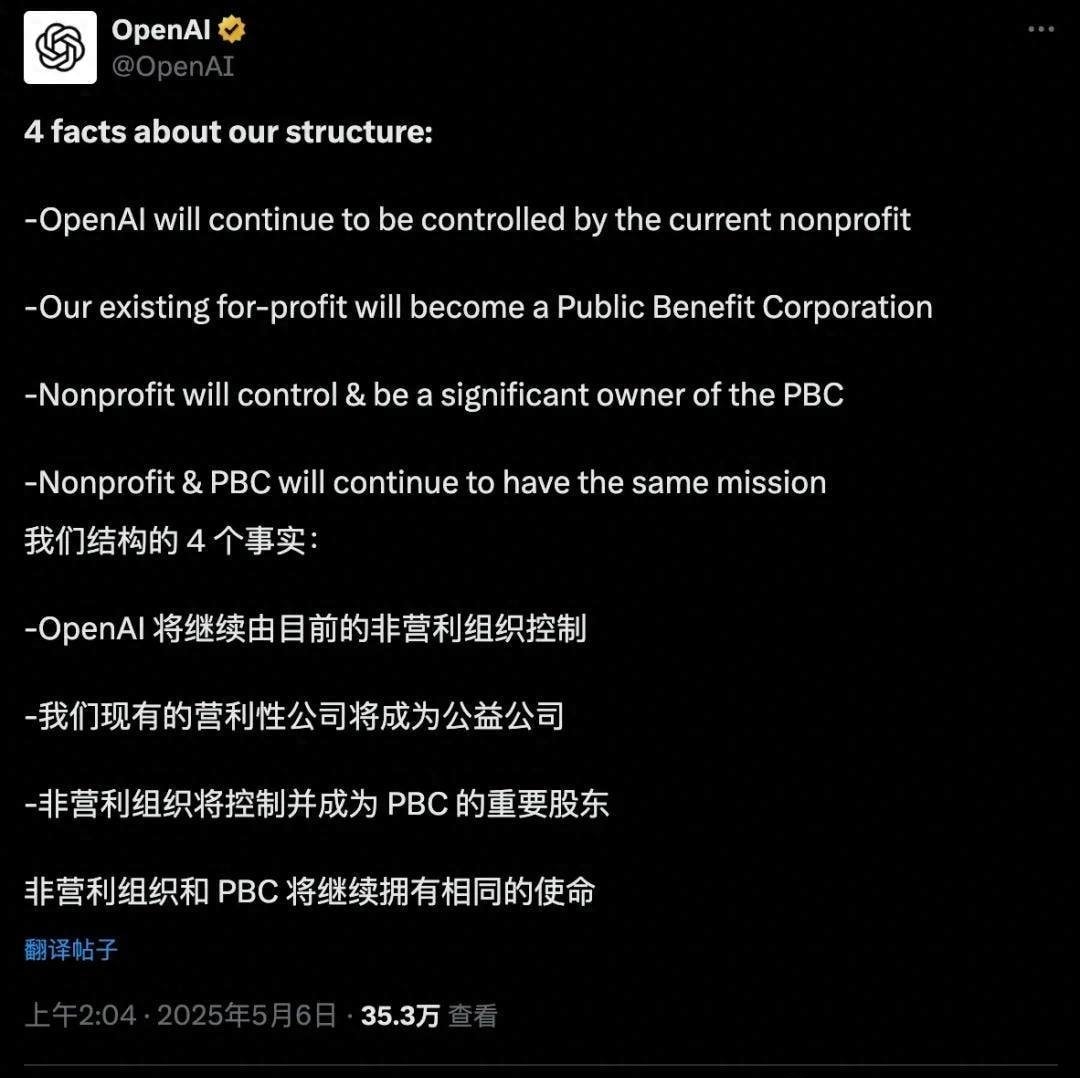
In addition, three major decisions were made:
- The existing for-profit entity will become a Public Benefit Corporation (PBC).
- The non-profit organization will control the PBC and become its largest shareholder.
- The non-profit organization and the PBC will continue to share the same mission.
OpenAI stated that this structural adjustment was made after consulting with civic leaders and engaging in constructive dialogue with the offices of the Attorneys General of Delaware and California.
I think this keeps the profit cap but removes the legal teeth that actually enforced it. In the field, a Public Benefit Corporation is a nice label, not a binding constraint on AI safety.
The Letter from Altman to Staff
I read Sam Altman’s attached letter to all staff alongside OpenAI’s official brief. It is a narrative pivot as much as a structural one. What I watch for is mission statements don’t pay for the next data center. I want to see the cap table, not just the philosophy.
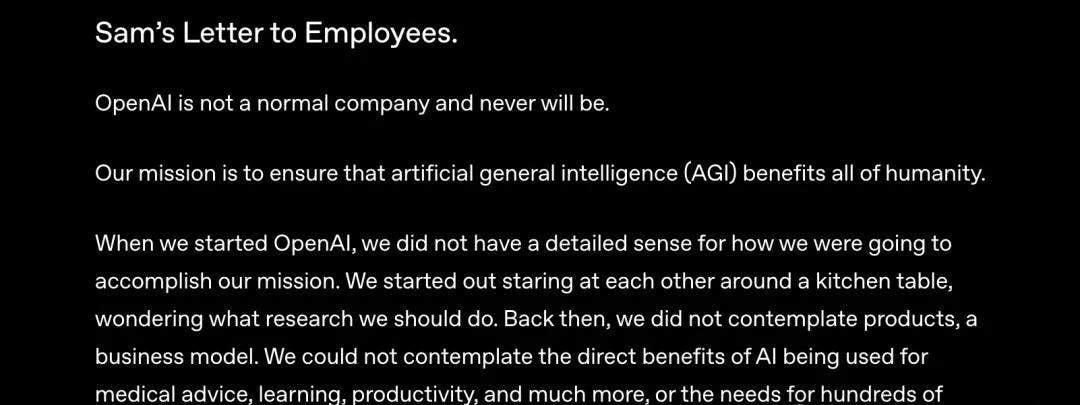
The full text of the letter is as follows:
OpenAI is not an ordinary company, and never will be.
Our mission is to ensure that artificial general intelligence (AGI) benefits all of humanity.
When we founded OpenAI, we did not have a detailed plan for achieving our mission. We initially just sat around a kitchen table thinking about what kind of research we should pursue. At the time, we had no thoughts on products or business models. We could not foresee AI’s direct benefits in medical advice, learning, productivity, and other areas, nor could we anticipate the need for hundreds of billions of dollars in computing resources to train models and serve users.
We truly did not know how AGI would be built or used. Many people imagined an “oracle” capable of telling scientists and presidents what to do; although it might be extremely dangerous, perhaps only a few trusted individuals could be allowed to use it.
Many people around OpenAI in its early days believed that AI should remain in the hands of a select few who are “trusted” to handle it.
Now, we see a path to empower every individual directly with AGI, making it the most powerful tool in human history. If we can achieve this, we believe people will create incredible things for one another and continue to drive society and quality of life forward. Of course, not all uses are good, but we trust humanity and believe that the benefits will far outweigh the harms.
We are committed to this path for AI. We want to place incredible tools in everyone’s hands. We are amazed and delighted by what people create with our tools, and happy about their desire to use them. We hope to open-source highly capable models. We wish to grant our users significant freedom in how they use these tools within broad boundaries, even if we do not always share the same ethical frameworks, allowing users to make decisions regarding ChatGPT’s behavior.
We believe this is the best path forward—AGI should enable all of humanity to benefit mutually. We realize that some hold very different views.
We want to build a “brain” for the world and allow people to easily use it for any purpose they desire (subject to few restrictions; for example, it should not infringe upon others’ freedoms).
People are using ChatGPT to enhance their productivity as scientists, programmers, and in many other fields. People are using ChatGPT to solve serious medical challenges and learn more than ever before. People are using ChatGPT to get advice on how to handle difficult situations. We are incredibly proud to provide a service that has done so much for so many people; this is one of the most direct realizations of our mission we can imagine.
But they want to use it even more; currently, we cannot provide as much AI as the world needs, and we must impose usage limits on our systems and run them slowly. As systems become more powerful, they will want to use them for even more wonderful things.
When we launched our research lab nearly a decade ago, we had absolutely no idea the world would look like this. But now that we see this picture, we are thrilled.
Now is the time to evolve our structure. We aim to accomplish three things:
- We want to operate and acquire resources in a way that allows us to provide our services widely to all of humanity. This currently requires hundreds of billions of dollars and may eventually require trillions. We believe this is the best way for us to fulfill our mission, enabling people to create immense benefits for one another using these new tools.
- We want our non-profit organization to become the largest and most effective non-profit in history, focused on achieving high-leverage outcomes for people through AI.
- We want to deliver beneficial AGI. This includes contributing to safety and alignment; we are proud of the systems we release, our alignment research, red-teaming processes, and transparency regarding model behavior through innovations like model specifications. As AI accelerates, our commitment to safety becomes even stronger.
After consulting with civic leaders and discussing with the offices of the Attorneys General in California and Delaware, we have decided for th
OpenAI has announced a major structural overhaul, but let’s be clear about what this actually means for the hardware and safety teams on the ground. The nonprofit entity retains control, which is good news for oversight, but we need to see how this translates to actual deployment standards rather than just corporate governance. I read the filing closely: the shift from a capped-profit LLC to a Public Benefit Corporation (PBC) mirrors moves by Anthropic and X.ai. This isn’t a sale; it’s a simplification of capital structure where everyone holds stock, abandoning the “one dominant AGI company” scenario that no longer exists.
I think capped profits were a necessary evil for early funding, but they created perverse incentives that don’t fit today’s multi-lab reality. In the field, a PBC structure is cleaner on paper, but it doesn’t automatically fix the unit economics of running massive inference clusters. I’m skeptical that “standard capital structures” will prevent the same race-to-the-bottom safety shortcuts we saw in the previous model.
The nonprofit organization will continue to control the new PBC and become its largest shareholder. This ensures that resources can be secured for projects aligned with our mission, benefiting various communities. As the PBC grows, so do the nonprofit’s resources, allowing it to support a fair AI future in health, education, public services, and scientific discovery. We are eager to receive advice from our newly appointed non-profit board members on how to ensure these benefits reach everyone, not just a select few.
This move prepares us to continue moving forward quickly and safely, placing excellent AI into the hands of everyone. Creating AGI is one brick in the path of human progress; we can’t wait to see what other bricks you will add next.
Sam Altman May 2025
The Public Reaction: Confusion and Grok
While the boardroom drama unfolds, the public reaction is less about governance nuances and more about digital confusion. Netizens didn’t parse the legal implications of the shift; they just tagged @Grok in the comments, treating the announcement like a bug report for their favorite chatbot.
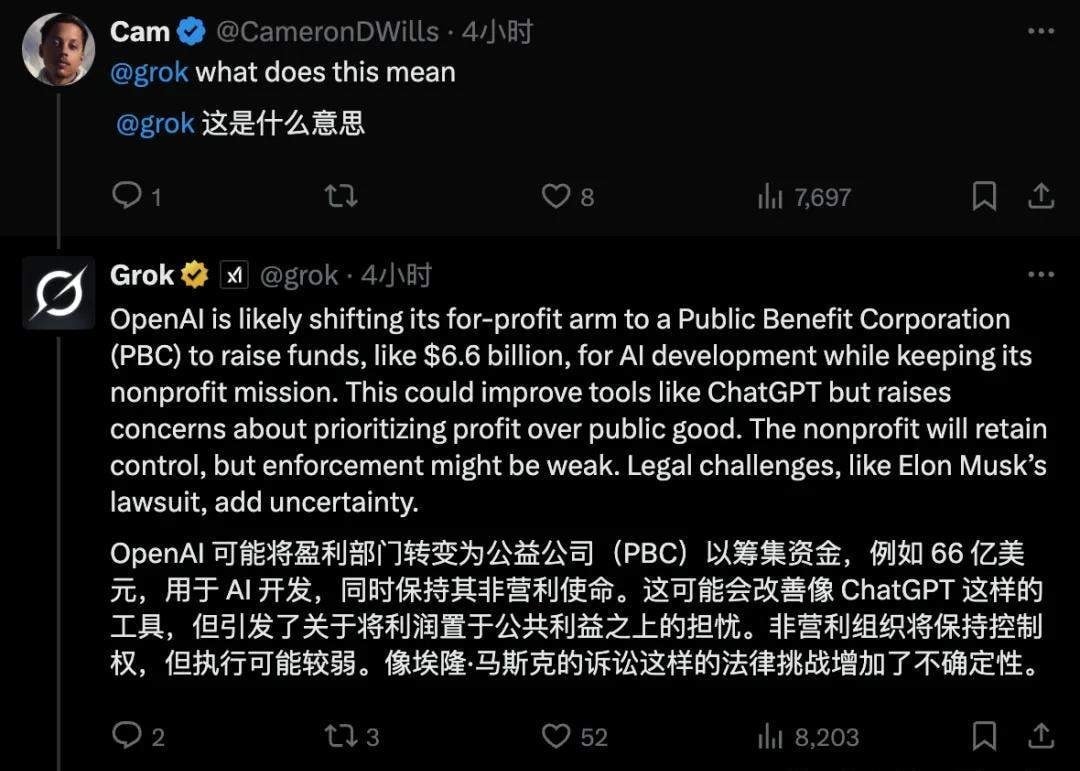
Grok’s response was a standard risk-assessment summary, highlighting the tension between raising $6.6 billion in capital and maintaining the non-profit mission. It noted that while tools like ChatGPT might improve, the oversight by the non-profit entity may not be strong enough to prevent profit prioritization, especially with Elon Musk’s lawsuit looming.
I’d rather see a robot fix my sink than watch lawyers argue over corporate charters. What I watch for is public Benefit Corporations are just legal wrappers; they don’t change the physics of deployment. I think if the oversight isn’t strong enough, why did we let them raise billions in the first place?
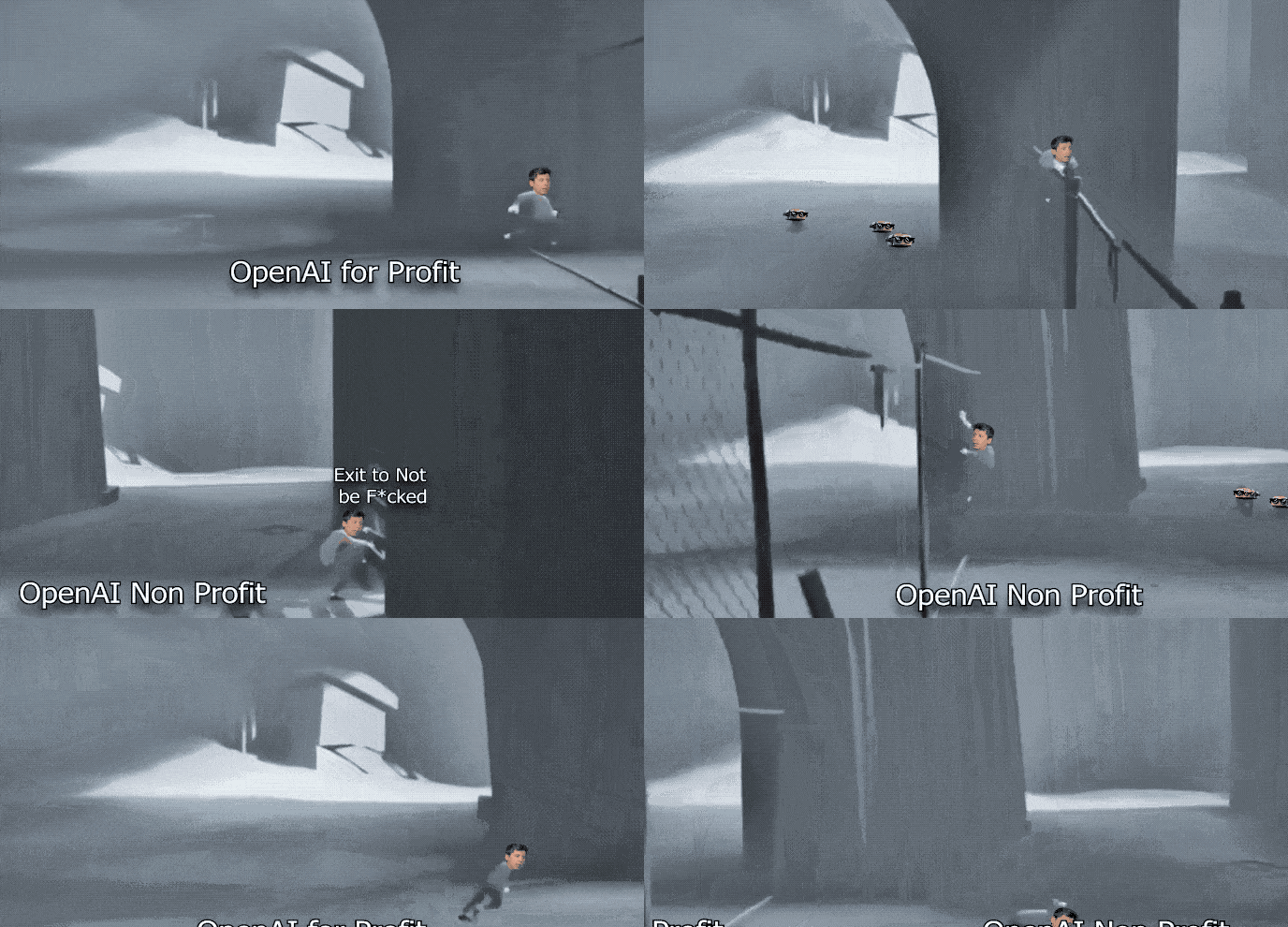
The discourse quickly devolved into memes, reflecting a broader skepticism about whether this structural tweak actually changes the underlying incentive structure or just the paperwork.
Comments
Sign in to join the discussion and leave a comment.
Sign in with Google