I read the transcript of Sarah Friar and Vinod Khosla’s latest podcast. They are positioning 2026 as the year multi-agent systems go mainstream, but I’m looking at the unit economics behind that promise.

The timing isn’t accidental. This release serves as a direct response to recent public skepticism and a reassurance for investors that “AI is not a bubble; OpenAI is worth investing in.” The subtext is clear: paving the way for OpenAI’s upcoming IPO. This will be the top priority for OpenAI in 2026.

Beyond the corporate narrative, the macro-perspective offers some specific data points I followed closely:
2026 will be the true year of agents.
There is a clear positive correlation between compute power and revenue.
The true indicator of an AI bubble is not stock price, but API call volume.
In ten years, global economies will enter an era of mass deflation due to AI.
Here are more details.
2026 Keyword: Multi-Agent Systems
OpenAI first established a consensus: 2026 belongs to multi-agent collaboration.
If 2025 saw AI development revolving around Agents and Vibe Coding, then 2026 will be the critical juncture where multi-agent systems mature and generate tangible impact.
At the enterprise level, multi-agent systems will handle a series of complete complex tasks, such as running Enterprise Resource Planning (ERP) systems, daily reconciliations, and real-time tracking of contract execution.
I think eRP integration sounds robust until you see how agents fail on edge-case invoices in live environments.
On the consumer side, multi-agent systems will be more pragmatic, comprehensively considering multiple dimensions like dietary preferences, flight schedules, and personal calendars when planning itineraries.

Additionally, many fields previously constrained by technical bottlenecks will gradually achieve breakthroughs in the future.
Taking large models as an example, their standard performance in memory capabilities, continuous learning, and hallucination suppression will see significant optimization.
Meanwhile, frontier directions such as embodied intelligence models and world models will also make substantial progress.
2026 will mark the beginning of a narrowing gap between technical capability and user experience.
Whether for enterprise or individual users, AI’s potential will be fully unleashed, transforming it from simple chatbots into true task executors.
Compute Equals Revenue
The gap between what we see in a demo reel and what actually runs on a factory floor is where the real money—and the real risk—lives. OpenAI’s latest data suggests they are betting big that more compute equals more cash, but I’m watching the unit economics closely to see if the hardware can keep up with the hype.
In the field, lab demos look great until you try to run them on a noisy factory floor. What I watch for is if the robot breaks down every hour, no amount of GPU power fixes it. I think safety protocols cost more than the chips themselves in the long run.
OpenAI views compute as the infrastructure of the AI era; whoever masters it gains the first-mover advantage. While heavy spending on compute may seem unprofitable at first glance, OpenAI argues it is highly lucrative: there is a strong positive correlation between spend and earnings.
Compute investment drives research and leaps in model capability. Powerful models lead to better products and wider adoption, which in turn drive revenue growth. Revenue then supports the next round of compute investment and innovation. This cycle reinforces itself continuously.
This point is corroborated by OpenAI’s latest published ARR (Annual Recurring Revenue) data. Over the past three years, OpenAI’s compute capacity has grown annually from an initial 200 megawatts to 1.9 gigawatts, with revenue correspondingly increasing from $2 billion to over $20 billion. They follow the same growth curve, showing a trend of continuous accelerated growth.
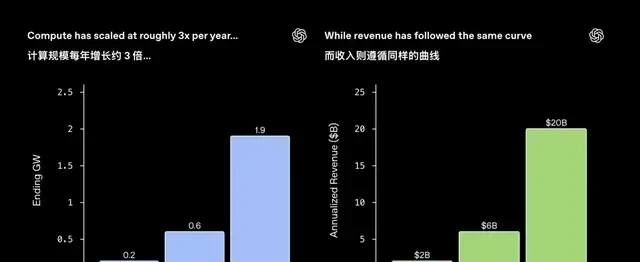
Clearly, OpenAI’s large-scale bets on compute power have been effective. However, it remains to be seen whether OpenAI has enough capital to sustain this level of spending. (doge)
In fact, not just OpenAI, but major global AI giants are all emphasizing the importance of compute power in unison. Elon Musk recently mentioned in an interview:
The currency of the future is essentially watts.
Trading compute for money has become an open secret within the AI industry. With more compute power, OpenAI can launch more products, models, and multimodal applications, leading to OpenAI’s next step—multi-dimensional transformation.
At the infrastructure level, OpenAI will achieve multi-cloud and multi-chip architectures to provide diverse support for underlying technology. For consumers, OpenAI will evolve from its initial single ChatGPT product into a multi-product structure (such as Sora, health modes, etc.).

In terms of business models, a multi-tier subscription system has already been formed. For example, offering Software-as-a-Service (SaaS) pricing for enterprises and introducing credit-based billing specifically for high-value scenarios. The recently added advertising business is also part of this strategy. By renting out the screens of its 800 million monthly active users to advertisers, OpenAI expects to generate billions of dollars in revenue this year.
However, there is no need to worry that ads will affect ChatGPT’s output results. OpenAI has explicitly stated that models will always provide optimal solutions for users rather than paid promotional answers.

They will also actively innovate ad formats to integrate naturally with the platform ecosystem, avoiding traditional banner ad models, while always retaining an ad-free service option to give users full choice. In the future, OpenAI is considering new licensing models. For instance, in drug development, it could license technology to partners; once they achieve breakthrough results, OpenAI would collect a percentage of pharmaceutical sales as licensing revenue, thereby aligning interests.
In short, OpenAI stated that it will combine the most suitable value modules from these three levels (infrastructure, products, and business models) to fulfill its ultimate mission of achieving AGI.
Rejecting Wall Street’s Bubble Theory: API Call Volume is the Hard Metric
OpenAI pushed back against the AI bubble narrative again. But let’s get the definition right first: volatility isn’t a bubble. Stock prices just reflect sentiment. The real metric for an AI bubble? API call volume.
Think about the internet era. We heard “bubble” everywhere, but network traffic was the truth-teller, not daily stock ticks. By that standard, API volumes aren’t dropping. If anything, Wall Street is manufacturing anxiety because the usage data doesn’t support a crash.
I’ve seen demo videos; I haven’t seen my local warehouse automate its entire intake yet. In the field, productivity gains are real in finance, but labor cost reductions take years to materialize on the P&L. What I watch for is contract extraction is useful, but it’s not a revolution until it handles ambiguity without human review.
The tangible benefit here is productivity enhancement. It’s about killing tedious repetition. OpenAI’s own finance team used to staff up for contract reviews. Now? Internal AI tools extract and store everything overnight. That saves time and labor costs.
McKinsey backs this up: the top 25% of companies saw financial productivity jump 27–33% thanks to AI. This lets employees pivot from drudgery to decision-making, creating higher economic value.

AI Technology Predictions
Two areas demand our attention: healthcare and robotics.
Healthcare is where AI will force a revolution. It gives doctors instant access to the latest research, clarifies drug interactions, and checks if treatments fit patient conditions. For patients, it offers autonomy—understanding symptoms early and preparing for better doctor conversations or second opinions.
The adoption numbers are already there: 230 million people consult ChatGPT about health weekly. In the U.S., 66% of doctors use ChatGPT daily, and that number is climbing. AI’s impact on healthcare has started; now regulators need to catch up.
I think doctors using LLMs for triage is efficient until it misses a rare symptom the model hasn’t seen. In the field, patient autonomy sounds great until someone self-diagnoses cancer based on a vague chatbot response.
Then there’s robotics. OpenAI predicts that in 15 years, the robotics market will dwarf today’s automotive industry. We haven’t seen breakthroughs yet, and technical hurdles remain massive. But look beyond manufacturing. Robots might solve human loneliness and provide companionship.
With an aging population, humanoid robots gain value simply by offering emotional support. That shift is what could push the industry’s valuation past cars.

This ties into a broader economic shift. As AI integrates deeper, we’re heading toward mass deflation in the next decade. Labor costs will plummet—becoming nearly free. Specialized knowledge and goods will become cheaper too.
Musk argues that output growth will outpace money supply growth, causing deflation. We might reach a point where distributing cash to everyone leads to “too much to spend.” It’s a radical view of post-scarcity economics.
What I watch for is deflation sounds nice until your employer cuts wages because labor is “nearly free.” I think emotional value from robots is hard to scale; loneliness is a complex human problem, not just a service gap.
For startups, OpenAI’s advice is clear: don’t compete on general models. Focus on specific domain data assets—enterprise data behind firewalls or complex workflow management. Traditional industry experience matters less now. The moat is built by proactively driving events forward and making your own value scarce.
References
I read through these sources to ground my editorial take in what the company is actually saying about its future.
- State of the AI industry — the OpenAI Podcast Ep. 12 — OpenAI CFO Sarah Friar and Khosla Ventures founder Vinod Khosla argue the greatest challenges in AI right now are keeping up with demand and making sure more…
- a business that scales with the value of intelligence — openai.com/index/a-business-that-scales-with-the-value-of-intelligence/
Comments
Sign in to join the discussion and leave a comment.
Sign in with Google